Advancing low-light AI imaging: Arm’s NTIRE 2026 success
Discover how Arm researchers used generative AI to improve low-light image enhancement for real-world AI vision systems.
By Idit Diamant

This blog is published on behalf of Idit Diamant, Yuval Haitman, Ariel Lapid, Reuven Peretz, and the Applied AI Research team
Advances in computer vision (CV) are foundational to modern AI systems, powering how machines perceive, interpret, and interact with the world. However, capturing high-quality images in low-light conditions remains a persistent challenge in CV.
Whether it is improving photos on smartphones, enabling safer autonomous systems, or enhancing visibility in edge AI applications, the ability to restore detail, color, and clarity is critical. Low-light image enhancement (LLIE) helps restore visibility, color, and detail when images are captured in difficult lighting conditions.
However, traditional LLIE techniques often involve difficult trade-offs. They can improve brightness and contrast, but they can also lose fine details, introduce artifacts, or produce overly smooth results that do not reflect natural images.
The Low-Light Image Enhancement Challenge
AI research is helping address these trade-offs by exploring models that can improve perceptual quality while preserving structure, texture, and scene realism.
As part of the NTIRE 2026 Low-Light Image Enhancement Challenge, associated with the CVPR 2026 Workshops, the Arm Applied AI Research (AAIR) team developed the Latent Flow-Matching Model for Low-Light Image Enhancement (LFM-LLIE).
The model won the non-reference track in the Low-Light Image Enhancement Challenge. LFM-LLIE applies and adapts latent flow matching to the low-light image enhancement problem, while incorporating a hierarchical transformer-based architecture (HDiT). As explained in this paper, the approach shows strong perceptual results in benchmark evaluation. However, the broader challenge findings also show that more work is needed to close the gap between benchmark performance and real-world image quality, and visual realism.
Why low-light image enhancement remains a significant engineering challenge
Low-light image enhancement involves more than increasing image brightness. An effective enhancement model must recover natural lighting, preserve color, maintain fine textures, and avoid visual artifacts.
Low-light images often contain several forms of degradation at once, including poor contrast, weak color information, loss of detail, and sensor noise. These conditions make it difficult to improve visibility without introducing new visual issues.
The NTIRE 2026 challenge focused on this real-world problem by evaluating methods on low-light data designed to better reflect practical image degradation. This matters because many LLIE models perform well on benchmark datasets, but struggle with conditions that differ from training data or when images contain more complex lighting and noise patterns.
How LFM-LLIE approaches low-light image enhancement
LFM-LLIE treats low-light image enhancement as a transformation task. Instead of directly editing pixels, the model maps low-light image representations to normal-light image representations in a compact latent space.
Operating in latent space enables the model to focus on semantically meaningful image information instead of only working at the pixel level. This helps the model focus on image structure, lighting, and texture patterns that support more realistic restoration.
The approach is designed to:
- Recover natural lighting and color;
- Restore fine textures and structural details;
- Reduce the risk of overly smooth or artificial-looking results; and
- Improve perceptual quality in challenging low-light benchmark scenarios.
What makes latent flow matching different for LLIE
A key contribution of LFM-LLIE is its application of latent flow matching to the LLIE domain. Flow matching is a generative modeling approach that learns a transformation path between data distributions. For LLIE, this means the model learns a structured restoration process rather than applying a direct brightness adjustment.
The AAIR team combined this approach with HDiT, a hierarchical transformer-based architecture. This architecture enables the model to capture both global scene context and fine-grained visual details, which are important for low-light restoration. Instead of only increasing brightness, the model learns a structured restoration process that preserves detail, reduces artifacts, and produces more natural-looking images.
This distinction is important because many LLIE methods improve visibility but also introduce smoothing, color shifts, or artifacts. LFM-LLIE shows how generative AI techniques can support image restoration tasks where perceptual quality is as important as numerical accuracy.
In benchmark evaluation, LFM-LLIE showed strong perceptual quality and fewer visible artifacts than many existing approaches, particularly in challenging low-light scenarios.
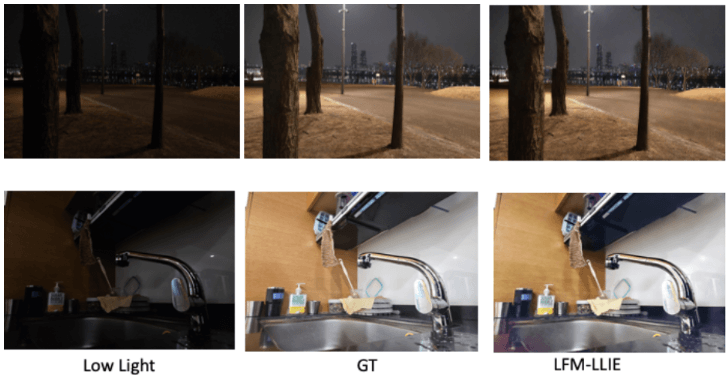
Research implications for AI vision
Beyond image quality, the approach points to several areas of future research and application:
- Higher perceptual quality, with more natural colors, sharper textures, and fewer visual artifacts;
- Efficient processing with a compact latent-space formulation that may support further optimization;
- Scalable design, with the unified framework in the model replacing more complex multi-stage pipelines; and
- Broad applicability, from mobile photography to edge AI and vision systems.
This matters as AI vision systems move into more varied environments where image quality, reliability, and practical deployment constraints must be considered together.
Why this research matters for AI vision
Low-light image enhancement is more than a niche problem. It is foundational to how AI systems perceive and respond to the physical world. As AI systems expand across cloud, edge, and endpoint environments, visual understanding must operate in more varied and unpredictable conditions.
This research is relevant to areas such as:
- Mobile and consumer imaging;
- Robotics and autonomous systems;
- Security and surveillance applications; and
- Edge AI deployments in real-world environments.
Improving low-light image quality can also improve the visual inputs used by downstream AI tasks, including object detection, scene understanding, and decision-making in difficult lighting conditions.
Looking ahead: from benchmark gains to real-world performance
LFM-LLIE represents an important research step in applying generative AI techniques to low-light image enhancement. By combining latent flow matching with a hierarchical transformer-based architecture, the AAIR team demonstrated an effective approach for improving perceptual image quality in a competitive benchmark setting.
The broader challenge findings show that low-light enhancement remains an open research problem. Future work must continue to address artifacts, real-world generalization, and practical deployment constraints.
As AI vision systems expand across devices and environments, research like LFM-LLIE helps advance models that interpret visual information more reliably, even in poor lighting conditions.

By Idit Diamant
Re-use is only permitted for informational and non-commercial or personal use only.
