Arm Create AI Optimization Challenge: Meet the winners
Discover the winners of the Arm Create: AI Optimization Challenge and how their projects explore AI optimization across Cloud, Mobile, and Physical AI
By Avin Zarlez
The Arm Create: AI Optimization Challenge invited developers to optimize AI workloads for Arm-based platforms. The challenge covered cloud, mobile, and physical AI environments.
The response was huge, with more than 330 submissions received across the challenge. Our judging team reviewed a strong field of projects, with many demonstrating thoughtful approaches to AI optimization and practical use of Arm technology.
Our judging team selected 5 projects for the Grand Prize, Runner-up, and category awards.
Here are the winners.
Grand Prize: Literally the Smallest 0.5B Param Functional LLM ever built
This project explored the limits of local large language model inference on highly constrained hardware.
The team built a custom inference framework for a 0.5B-parameter model. The framework used quantization, memory mapping, and Arm NEON optimization. The result was a working LLM experience that ran directly on Apple Watch hardware. A watchOS interface enabled users to enter prompts and receive responses locally.
The project shows how target-device constraints can drive optimization. The team considered memory use, inference performance, and the end-user experience together.
Explore the Grand Prize project on Devpost
Runner-up: ATOM: 12x More AI agent throughput per Arm core
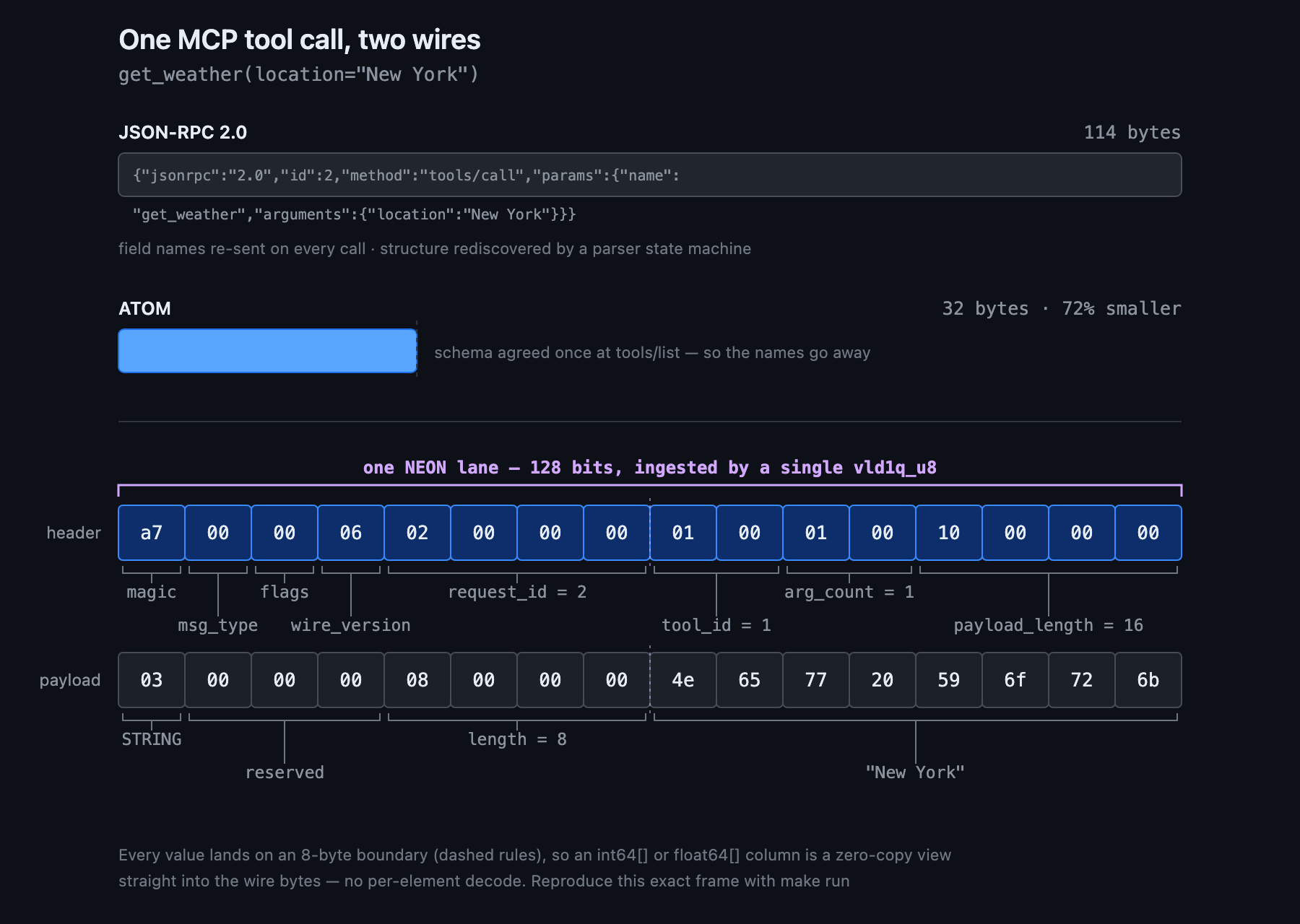
ATOM focused on a different part of the AI stack: communication between AI agents and tools.
The project explored a more compact, schema-aware binary format for the Model Context Protocol tool-call path. The format could replace repeated JSON-RPC messages. The aim was to reduce processing and data in frequent agent-to-tool interactions. The team also designed the format with Arm architecture in mind.
ATOM shows that optimization can extend beyond the model. Developers can also examine the surrounding infrastructure for performance and efficiency gains in agentic AI systems.
Best in category: Cloud AI — NightShift
NightShift explored whether very large AI models could perform useful developer tasks using Arm-based cloud CPUs without relying on GPUs.
The project runs large mixture-of-experts models in an Azure Cobalt 100 Arm CPU environment. It applies the models to pull-request review, issue triage, code generation, and other developer workflows.
The project also tested Arm-specific optimizations, including custom kernels and CPU-focused inference. It also demonstrated multiple developer tasks running concurrently on the same Arm CPU virtual machine.
NightShift shows that not every Cloud AI workload needs an instant response. Some developer tasks can use asynchronous CPU-based inference instead.
Best in category: Physical AI — TinyMOSS-Diarize
TinyMOSS-Diarize focused on making a speech transcription and speaker-diarization model practical on memory-constrained Arm devices.
The project uses quantization and custom Arm NEON kernels to reduce the model memory footprint. It keeps the packed representation during inference. The resulting speech model runs entirely on-device. It can transcribe audio, add timestamps, and identify different speakers.
The project shows what developers must consider when deploying capable AI models on smaller systems. Memory use and efficient execution are critical to deployment.
| Module | Components | Scheme | Effective bits |
|---|---|---|---|
| Qwen3 decoder projections | 196 | Sherry STQ1, per-group g=128 + FP16 scale | 1.375 |
| Whisper encoder projections | 144 | RTN W4, per-group g=128 + FP16 scale | 4.125 |
| embed_tokens (tied lm_head) | 1 | RTN W4, per-channel | 4.015625 |
| Residual tensors | 538 | BF16 | 16.0 |
| Aggregate | 879 | -- | 2.9110 |
Explore TinyMOSS-Diarize on Devpost
Best in category: Mobile AI — Voxel
Voxel looked at a common assumption in mobile AI runtimes: that CPU cores supporting the same instruction set should be treated in the same way.
Modern mobile Arm SoCs combine different CPU cores with different performance characteristics. Voxel detects the microarchitecture of the cores available on the device and adjusts how LLM inference work is distributed between them. The project uses different strategies for the compute-heavy prefill stage and the memory-bound decode stage, with an automatic scheduling policy designed to make better use of heterogeneous Arm CPU cores. It was demonstrated on a Pixel 8 as an on-device assistant capable of turning natural-language requests into Android actions.
By looking beyond instruction-set support and considering the characteristics of the individual CPU cores themselves, Voxel demonstrates how more hardware-aware scheduling can help developers optimize on-device AI workloads for modern mobile systems.
| Result | voxel | llama.cpp | |
|---|---|---|---|
| Time to first action, X3 | 0.54 s | 0.65 s | +17% |
| Time to first action, A715 | 0.75 s | 1.02 s | +26% |
| Auto-policy vs llama.cpp's best config | 0.60–0.65 s / 2.40 J | 0.66–0.67 s / 2.58 J | +7% energy |
| Capability-weighted prefill, 9 cores | 137.3 t/s | our own even split, 69.2 | +98% |
How the winning projects approach AI optimization.
The winning projects took very different approaches to AI optimization. Some focused on fitting AI into constrained devices. Others focused on model execution, cloud infrastructure, agent communication, or the surrounding data-processing pipeline
Together, they show that AI optimization is not a single technique. Effective AI optimization often starts with identifying the main workload constraint. Developers can then redesign the workload to address that constraint.
Congratulations to all five winners and thank you to everyone who took part in the Arm Create: AI Optimization Challenge.
With more than 330 submissions, the judging team had no shortage of strong projects to consider. We appreciate the time and creativity every participant brought to the challenge. If you were not able to join us on October 6th for our Arm Create: AI Optimization Challenge Winners Showcase, please check out the recording below.

By Avin Zarlez
Re-use is only permitted for informational and non-commercial or personal use only.
