Why Arm Cortex-M and Cortex-R are foundational to robotics
Discover how Arm Cortex-M and Cortex-R processors provide the real-time performance, reliability and safety foundations for next-generation robotics.
The Missing Science of Robotic Systems white paper by Arm’s lead robotics researcher Federico Pecora explores a fundamental challenge facing the robotics industry. Building increasingly capable robots is not simply a question of adding more AI compute, it is a systems challenge and how to bring together perception, reasoning, planning, control and safety into a cohesive robotic system.
One consequence of this systems challenge is that workload placement becomes increasingly important.
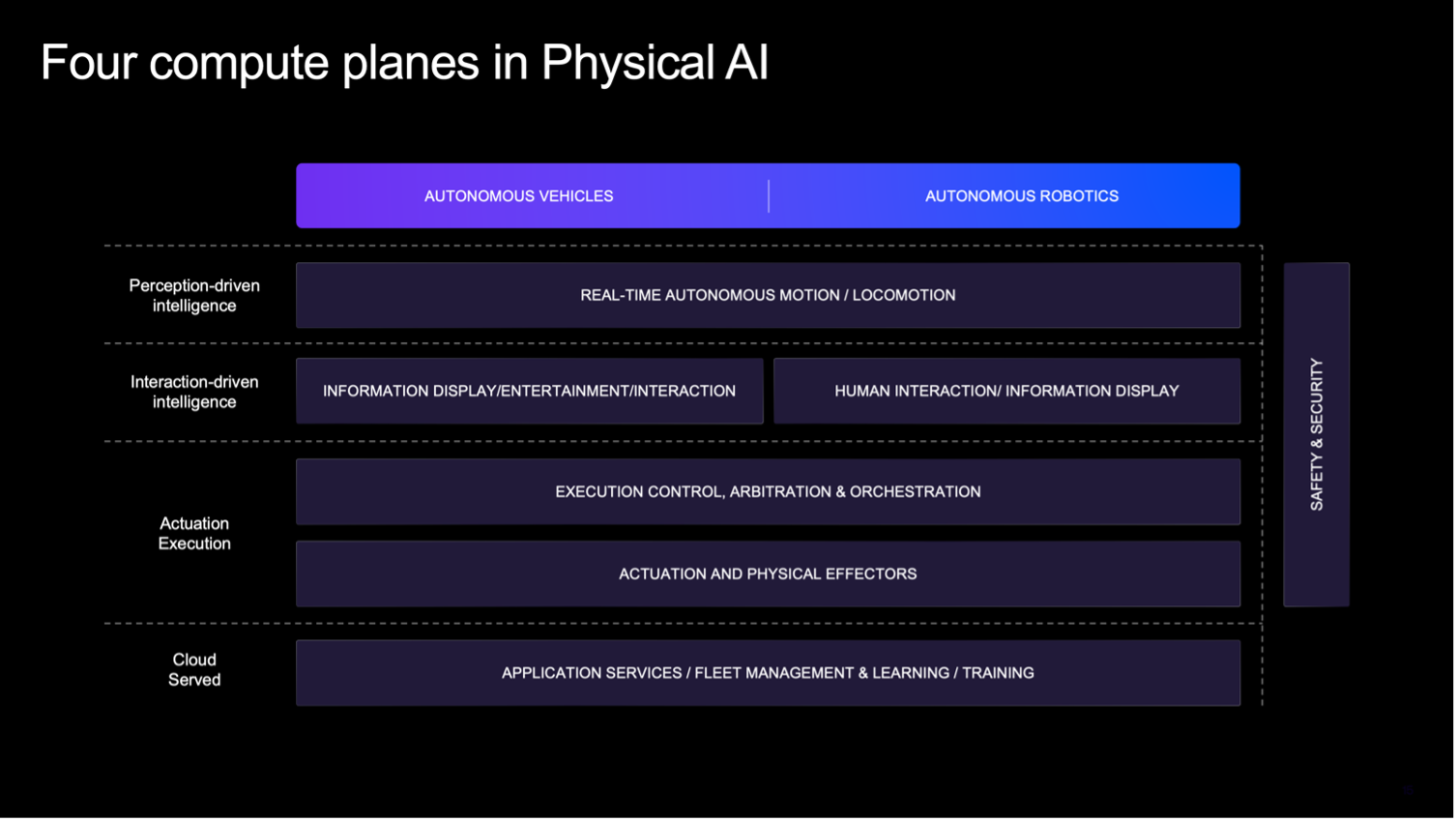
At Arm we consider that there are four compute planes that are critical to physical AI – namely perception-driven intelligence, interaction-driven intelligence, actuation and execution, and cloud-served capabilities, with the safety and security cutting across these planes vertically.
Each plane has distinct compute requirements. Perception, reasoning and planning demand high-performance processing and AI acceleration. Interaction-driven intelligence requires low latency processing of human intent and context. Execution, control and actuation depend on deterministic response, precise timing and efficient processing near sensors and actuators. All must operate within the system’s power, safety and reliability constraints.
This creates an important question for the robotic system designers: where should each workload execute? Which functions should execute close to the actuator? Which belong in a deterministic real-time domain? Which require high-performance application processing or acceleration? And how can these different compute domains interact while meeting the robot’s requirements for performance, power efficiency, determinism and safety?
AI in the perception and interaction layers is transforming what robots can understand and decide. But intelligence alone does not make a robot move.
Every AI decision must ultimately become physical action. Motors need to be controlled, sensors sampled, joints synchronized, with reliable and predictable execution of control tasks - such as safe motion, collision response, and controlled stopping - within precise deadlines. For robots operating alongside humans, these capabilities must also be integrated with appropriate system-level safety mechanisms. As robots become more autonomous, mobile and collaborative, this creates an equally important transformation beneath the AI layer: the growth of distributed embedded and real-time computing throughout the robot.
This is where Arm Cortex-M and Cortex-R processors have a vital role. Cortex-M provides efficient intelligence close to the physical endpoints, such as sensors and actuators, while Cortex-R addresses increasingly sophisticated deterministic, safety-critical and consolidated real-time control. Devices based on these processor families are already deployed across robotics and industrial-control applications, providing an established foundation as the market moves towards more intelligent and autonomous machines.
|
Vendor |
Device family |
Arm cores |
Target application |
|
ST |
STM32N6 |
Cortex-M55 |
Robotic vision including examples like object detection, gesture recognition |
|
ST |
STM32H7 |
Cortex-M7; Cortex-M7 + Cortex-M4 |
High-perf joint and motion control |
|
ST |
STM32H5 |
Cortex-M33 |
Motor control, robotics joints |
|
Renesas |
RA8T1 |
Cortex-M85 |
Motor control, AC Servo motor |
|
Infineon |
XMC4700 |
Cortex-M4 |
Motor control |
|
Renesas |
RZ/T2M |
Cortex-R52 |
AC Servo, industrial robot control |
|
TI |
M263x |
Cortex-R5F |
Motor control & automation MCU |
|
NXP |
i.MX RT1170 |
Cortex-M7 + Cortex-M4 |
Motor control |
|
NXP |
S32Z2 |
Cortex-R52 + Cortex-M33 |
Multi-axis motor control, joint coordination, high-performance actuation |
|
Gigadevice |
GD32H75E |
Cortex-M7 |
high-end servo motor control |
|
SemiDrive |
E3119-R |
Cortex-R5F |
Motor drive with sensor feedback |
|
SemiDrive |
E3650R |
Cortex-R52 |
Motor controller |
Why Cortex-M for robotics?
A sophisticated robot is not one computer. It is a distributed system potentially containing dozens of motors, encoders, force sensors, battery-management functions, communications interfaces and other electronic subsystems.
Many of these functions do not require a powerful application processor. They need efficient processing that can respond quickly and predictably while operating within tight cost, area and power constraints.
That has long been the strength of Cortex-M based microcontrollers (MCUs).
The latest generation of Cortex-M processors extend this foundation with significant enhanced security, signal-processing, and machine learning capabilities. Arm Cortex-M23 brings Armv8-M Baseline architecture and TrustZone technology into highly constrained energy-efficient endpoint, while Arm Cortex-M33 adds digital signal processing (DSP) capabilities. Moving into the Armv8.1M architecture, Arm Cortex-M52 brings Arm Helium Vector Processing to a highly area-and-energy efficient implementation, Arm Cortex-M55 introduces a step-up in DSP and ML performance, and Cortex-M85 combines Arm Helium technology with class-leading scalar, DSP and machine learning (ML) performance. Arm delivers supporting collateral to enable these products to be used in safety applications.
Meanwhile, earlier processors such as Arm Cortex-M0 and Cortex-M0+ provide extremely efficient compute for simple control, sensing and auxiliary functions. Arm Cortex-M3 and Cortex-M4 extend this capability into more sophisticated embedded control, while Arm Cortex-M7 provides significantly greater performance for demanding control algorithms.
This scalability is particularly valuable in robotics because not every endpoint has the same compute requirement. A robot manufacturer can use the Cortex-M architecture across functions ranging from relatively simple sensor and power-management nodes to sophisticated motor controllers while benefiting from a common architecture and broad embedded software ecosystem.
Instead of sending every measurement back to a central processor, local MCUs can acquire position, current or force information, execute control algorithms and respond immediately. Higher-level processors can then concentrate on perception, planning and overall robot behaviour.
Consider a general-purpose robot asked to get a glass of water. The primary AI compute, such as an Arm Cortex-A-based processor, handles perception, reasoning and task planning, including understanding the request and identifying the glass, destination and obstacles. This planning establishes the required joint movement targets and constraints for the robot's arm. Cortex-M-based MCUs can then translate these targets into actuator commands, including force, direction and current, to carry out the required movements. Sensor feedback helps confirm the movement and make adjustments within a tight local control loop.
Bringing DSP and intelligence to the physical edge
The requirements of robotic endpoints are also changing.
A joint controller increasingly needs to do more than execute a conventional motor-control loop. It may process vibration information, combine multiple sensor inputs, detect anomalies or execute local machine-learning algorithms.
As noted above, Arm v8.1M based processors incorporate Helium technology, the M-Profile Vector Extension, bringing vector processing to the Cortex-M architecture. Helium significantly accelerates DSP and ML workloads while retaining the power and implementation characteristics needed by embedded systems.
For robotics, that combination is compelling. Helium-enabled Cortex-M processors can accelerate a wide range of DSP and ML workloads. Examples include signal processing for motor control, sensor fusion and edge ML tasks such as recognizing objects from sensor data or detecting abnormal joint vibration.
This allows DSP operations associated with motor control, sensor processing, filtering and signal analysis to increasingly execute alongside the conventional real-time control workload, while some less computationally intensive ML operations can also be carried out at the edge instead of involving the central computer.
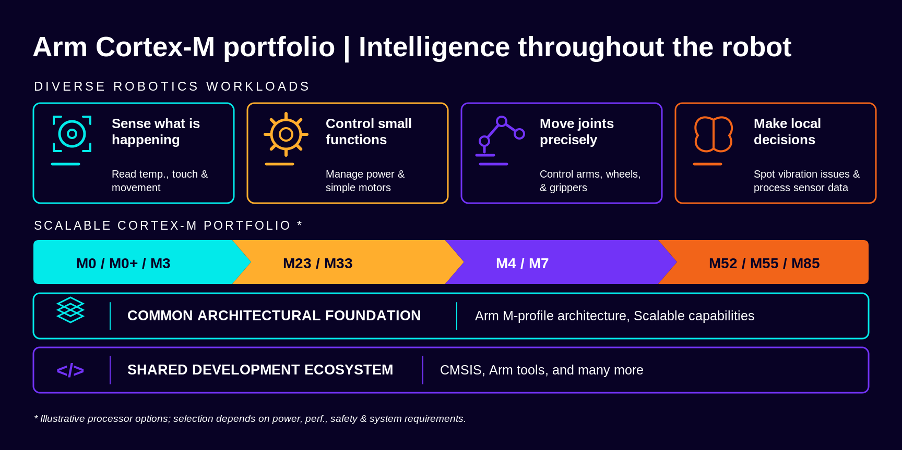
Cortex-M is evolving beyond traditional real-time controls, bringing sensing, signal processing and intelligence directly to the point of actuation.
Why Cortex-R for robotics?
As robots become more capable, another computing requirement emerges.
Some workloads need substantially greater real-time performance while preserving deterministic behaviour. Others need multiple safety-critical and non-safety functions to coexist without interfering with each other.
This is where Cortex-R becomes particularly interesting.
Robotic motion is fundamentally deadline-driven. In applications such as coordinated multi-axis control, dynamic balancing and high-performance servo control, average performance is not enough. The system must produce the correct result at the correct time.
Cortex-R is designed around high-performance deterministic execution, making it well suited to this class of workload.
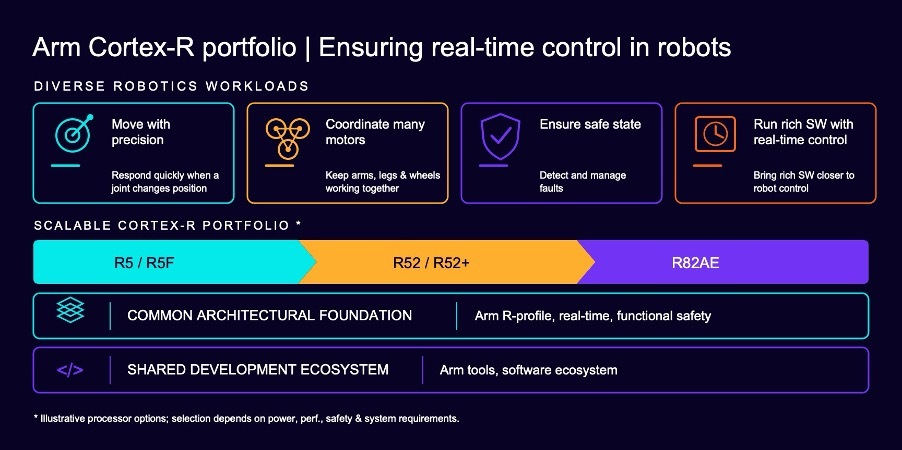
Cortex-R5 and Cortex-R5F have established a strong foundation for deterministic real-time computing in robotics and industrial automation. Their low-latency response, tightly coupled memory, and predictable execution make them ideal for motor control and coordinated joint movement.
But deterministic computing is only part of the story.
From distributed control to consolidated control
As robots become more complex, adding another MCU for every new function eventually increases hardware, wiring and software complexity.
The alternative is consolidation. By combining multiple functions onto fewer devices, consolidation can help reduce bill-of-materials (BOM) costs while improving software development efficiency through simplified integration, maintenance and management of software across the system.
A more capable real-time processor can potentially coordinate multiple control loops while simultaneously managing communications, diagnostics and safety functions. This creates a hierarchy in which Cortex-M remains close to individual sensors and actuators while Cortex-R provides a higher-performance deterministic control layer.
Virtualization makes that model considerably more powerful.
Arm Cortex-R52 and Cortex-R52+ provide hardware-supported virtualization and software separation. Multiple operating systems or software environments can coexist while hardware mechanisms help maintain separation between them.
For future robots, this could allow motor-control software, safety functions, communications and other workloads to be consolidated onto fewer controllers without simply combining everything into one software environment.
That becomes increasingly important as robots evolve into software-defined machines.
Arm Cortex-R82AE: bringing rich operating systems into real-time compute
The evolution becomes even more interesting with Arm Cortex-R82AE.
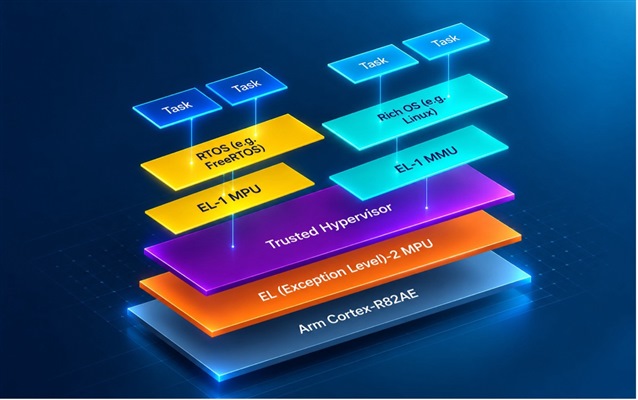
Cortex-R52/Cortex-R52+ use Memory Protection Units to provide controlled memory access and software separation. Cortex-R82AE adds a Memory Management Unit (MMU) alongside the real-time characteristics of the Cortex-R architecture.
That distinction has significant consequences.
An MMU enables virtual memory and the memory-management model required by rich operating systems such as Linux. The architecture can therefore support both rich operating systems and traditional real-time software environments.
Although Cortex-R82AE is positioned primarily for automotive today, the architectural capabilities for advanced robotics are worth considering.
A future high-end robot could need deterministic motion control, safety software, industrial communications, sophisticated middleware and Linux-based applications within the same real-time computing subsystem.
Traditionally, this could require multiple separate real-time and application processors.
An MMU-equipped Cortex-R processor raises another possibility: could part of the rich software environment move directly onto the real-time processor?
Consider a general-purpose robot asked to get a glass of water. The task introduces dynamically changing constraints: acceleration and jerk may be limited to avoid spillage, while grasp and orientation of the cup must be maintained throughout the motion. Higher-level software may derive and update the constraints based on the task and environment, while deterministic control software must enforce them with precise deadlines. Greater compute at this layer creates the possibility of migrating these functions closer together, while an MMU allows richer software environments to coexist with the RTOS workloads responsible for deterministic execution.
Virtualization could allow a rich OS and RTOS workloads to coexist while retaining separation between software domains.
This does not mean Cortex-R replaces Cortex-A-class application processors. High-performance perception, large AI models and complex application workloads will continue to require substantial application and accelerated compute.
Instead, Cortex-R82AE potentially could expand what the real-time layer itself can be capable of.
A new hierarchy of robotic compute
These trends and capabilities point toward a heterogeneous compute architecture for future robots.
At the top, high-performance application processors and accelerators perform perception, AI, planning and reasoning.
Beneath them, Cortex-R can provide deterministic coordination, safety, real-time networking and increasingly consolidated software-defined control.
Distributed throughout the machine, Cortex-M can manage motors, sensors, power systems and intelligent endpoints.
The hierarchy becomes:

Cortex-M and Cortex-R are therefore not simply competing for the same MCU socket.
Cortex-M scales with the number of intelligent endpoints. Cortex-R scales with the sophistication, safety requirements and level of consolidation within the robot.
AI may determine what a robot should do. But embedded and real-time computing enables the robot to translate that intelligence into physical action efficiently, predictably and safely.
That makes Cortex-M and Cortex-R not peripheral components of the robotics revolution, but increasingly important foundations beneath it.
As physical AI advances, Arm is enabling the compute foundation for increasingly intelligent and capable robotic systems. Discover how Arm technologies support the next generation of robotics, from AI processing to real-time control and sensing.

Re-use is only permitted for informational and non-commercial or personal use only.
