25 years of Buildroot: Simplifying embedded Linux on Arm
Celebrate 25 years of Buildroot and see how it helps Arm developers create reproducible embedded Linux systems for devices and intelligent edge workloads
Building an embedded Linux system has never meant building only a kernel. Developers also need a cross-compilation toolchain, bootloader, root file system, libraries, packages, and a repeatable way to assemble everything for the target hardware.
For 25 years, Buildroot has made that process more manageable. The milestone reflects the longevity of an independent, engineering-led open-source project that has evolved alongside embedded Linux itself.
The project traces its origins to 2001. At the time, embedded Linux systems looked considerably different from the systems developers build today. Devices now use faster processors, larger software stacks, more connectivity, and increasingly specialized workloads. Yet Buildroot continues to address the same fundamental engineering problem: creating a Linux system tailored to specific hardware without unnecessary build-system complexity.
From configuration to a complete embedded Linux image
Buildroot automates the process of creating the major software components an embedded Linux system needs. Depending on the configuration, that can include the cross-compilation toolchain, Linux kernel, bootloader, root filesystem, libraries, application packages, and final images used on the target.
Developers describe the system they want through Buildroot configuration options. Buildroot then resolves dependencies and builds the selected software into a consistent target image.
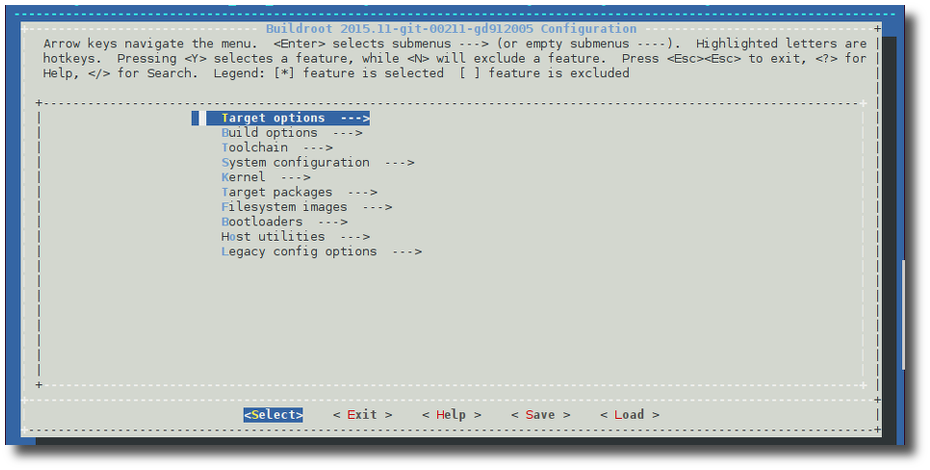
Buildroot’s menu-driven configuration interface lets developers select target options, toolchains, kernels, packages, filesystem images, and other components for an embedded Linux system.
That model suits systems where developers want close control over what runs on the device. Instead of starting with a general-purpose Linux distribution and removing components, teams can select the software their system requires from the beginning.
That direct relationship between configuration and output also supports reproducible builds and automated development workflows.
Buildroot also extends beyond image generation, with tooling that helps developers understand, validate, and maintain the resulting system. The tooling covers legal and licensing information, Software Bill of Materials generation, security impact monitoring for known vulnerabilities, and runtime testing in emulated environments.
Growing alongside Arm embedded Linux
Buildroot and Arm-based embedded Linux have evolved alongside each other for much of the past 25 years.
As Arm processors became common across embedded boards and devices, Buildroot added and maintained architecture, toolchain, bootloader, kernel, and board support, from earlier 32-bit Arm platforms through Armv7 systems and into AArch64.
Current upstream configurations illustrate that breadth. Buildroot includes configurations for Arm-based platforms such as BeagleBone and multiple generations of Raspberry Pi, along with virtual Arm environments including AArch64 QEMU targets. These provide known starting points that developers can adapt to their own hardware and software requirements.
Buildroot remains an independent open-source project. Its connection with the Arm ecosystem comes through support for Arm architecture and hardware boards, engineering use, and upstream contributions.
“Open source has long been central to software development on Arm. For 25 years, Buildroot has offered developers a straightforward way to build Linux systems, supporting the Arm architecture from its earliest days to today’s platforms. Its longevity demonstrates how an engineering-led open-source project can evolve across generations while continuing to solve practical problems for developers”
- Mark Hambleton, SVP, Software, Arm,” said Mark Hambleton, SVP, Software, Arm
Where Buildroot fits in the development workflow
For developers on an Arm-based system, one of Buildroot’s practical advantages is the short path from selecting a target configuration to producing a Linux image that can boot on that target.
That makes it useful for several recurring engineering jobs.
During early hardware bring-up, a small Linux environment can provide a controlled platform for testing processors, memory, storage, networking, and peripherals before a larger software stack is ready.
For constrained devices, developers can choose the packages and libraries they need rather than carrying a broad distribution by default. That control matters when flash capacity, memory use, boot time, or overall software footprint are design considerations.
Because configurations can be stored alongside source code, teams can also rebuild consistent images as software changes and incorporate them into testing and continuous integration.
A quiet part of the Arm software ecosystem
Build systems rarely appear in product specifications or user interfaces. Their work happens earlier, between hardware enablement and the software users eventually see.
That can make Buildroot less visible than the operating systems, applications, and devices built with it.
The upstream project provides one indication of the breadth of that work. Its maintained configurations cover numerous boards and virtual platforms, while contributors continually update packages, kernels, bootloaders, toolchains, and architecture support.
For Arm developers, those configurations span physical boards, readily available development hardware, and virtual environments for development and testing.
The larger point is not that Buildroot alone enables these platforms. It provides foundational build infrastructure that teams can adapt as part of a much larger software and hardware stack.
Why the model still fits intelligent edge systems
The requirements of embedded Linux continue to expand. Robotics, industrial equipment, smart cameras, gateways, and other intelligent systems increasingly combine Linux with networking, sensors, inference runtimes, and application-specific software.
As these systems become more complex, many still benefit from a Linux environment tailored closely to their hardware and workload rather than a general-purpose image. Buildroot’s model maps naturally to the need for a Linux environment tailored to the hardware and workload. Developers select the required packages, configure the target, and produce a reproducible image
For an intelligent edge device, that can mean keeping the base system focused while integrating the software needed for networking, device management, inference, or application logic. Buildroot does not determine the application architecture, but it gives developers control over the Linux environment beneath it.
Simplicity does not mean standing still
Buildroot has evolved as the expectations placed on production embedded Linux have changed.
Current releases include tooling to report package information and known vulnerabilities, while Buildroot can generate CycloneDX Software Bill of Materials data for use by other software-management tools. Its legal-info functionality collects licensing, source, configuration, and other material relevant to software-compliance workflows.
The project's release process has evolved as well. Buildroot now provides long-term support releases with a three-year maintenance period alongside its regular stable releases.
That reflects a broader shift in commercial embedded development: producing a bootable image is only part of the job. Teams need software visibility, vulnerability tracking, license management, updates, and long-term maintenance.
Buildroot has added those capabilities while retaining a build model designed to remain understandable and controllable.
25 years of engineering continuity
Buildroot's longevity is a community story.
For 25 years, maintainers and contributors have continued the less-visible engineering work required to turn source code and configuration into usable embedded Linux systems. Architectures, toolchains, Linux itself, and the systems built around them have all changed.
But developers still need a dependable path from processor and board support to a controlled Linux image. As Arm-based systems take on more software and intelligence, that foundational requirement remains.
Twenty-five years after Buildroot began, developers still need the controlled, repeatable build process that the project set out to provide. Its anniversary is also a chance to recognize the many open-source technologies and communities, including Buildroot, that Arm developers rely on to turn new hardware into working systems.

Re-use is only permitted for informational and non-commercial or personal use only.
