Faster embedded product innovation with Arm and Renesas
Xplore Developer Hub shows how reusable Arm-based hardware and use-case driven software can help developers combine embedded capabilities, accelerate prototyping and avoid rebuilding the same development foundation for each new application

This blog post is co-authored by Reinhard Keil, Sr Director of Embedded Technology, Arm and David Renno, Director of Product Enablement, Renesas
Developing new embedded products often means evaluating different hardware and software technologies before a concept can be validated. This takes time, adds engineering effort and can limit how quickly teams explore new product opportunities. Rapid prototyping helps reduce that friction by giving developers a faster way to test ideas, compare approaches and identify what works before committing to a full product design.
Renesas has spent more than a decade developing Arm-based embedded solutions, combining scalable compute with software and development tools that help customers move from concept to production quicker. Xplore Developer Hub builds on that foundation, bringing together reusable Arm-based microcontroller (MCU) hardware, expansion boards and use-case driven software to simplify rapid prototyping and make it easier to evaluate different combinations of technologies. Users can access Xplore via Renesas 365 , an open, intelligent development platform that connects solution discovery to system development and lifecycle management in a single environment.
With a common Arm architecture and software foundation, Xplore allows and developers to combine capabilities such as sensing, connectivity, control and local AI, test new ideas faster, and carry more of their development investment forward as products evolve.
How Xplore simplifies hardware and software integration
The applications themselves may look very different, but many rely on the same underlying engineering capabilities. A connected sensor may need wireless communication and data management. A motor-control application combines device control with connectivity. A smart-lighting product may bring together connectivity, control, security and an application interface.
Recreating those foundations for every new concept adds time and integration work before teams can focus on what differentiates the product. Reusing established hardware and software building blocks offers a different approach:
- Start with capabilities that already work;
- Combine them around the requirements of the application; and
- Move more quickly toward a working prototype.
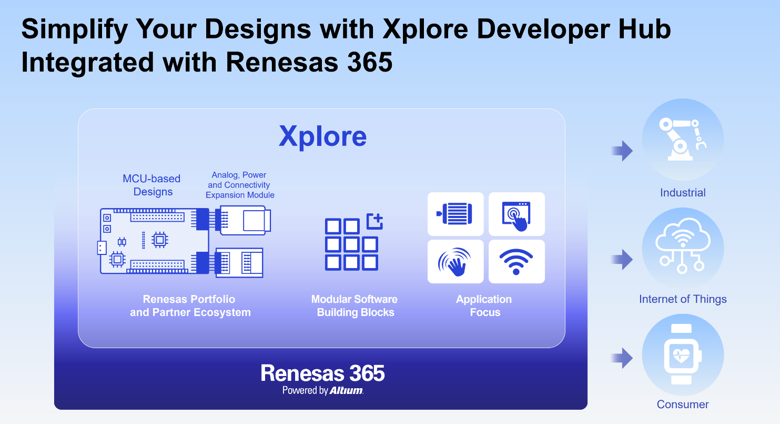
Diagram showing Xplore Developer Hub integrated with Renesas 365 on common Arm architecture and software foundation helps to simplify and accelerate designs.
This modular approach extends into Xplore’s software model, with capabilities spanning connectivity, security, device control, networking, diagnostics, data management and human-machine interfaces. Developers can combine and configure these building blocks around real embedded use cases and experiment with different configurations as part of a complete system.
Xplore also connects to a broader Renesas development environment. Through Renesas 365, powered by Altium, developers can access tools, code, hardware, community resources, and training on one platform. This environment supports more than 550 RA MCU variants.
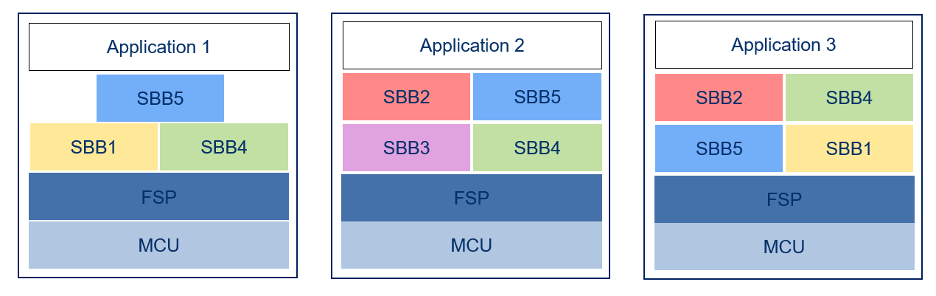
Xplore evaluation boards use a consistent set of I/O interfaces, allowing developers to evaluate different devices without rebuilding the prototype environment for each candidate. Pre-tested code blocks further accelerate the path from evaluation to proof-of-concept. Once a concept has been validated, teams can build on the hardware, software and development work already in place rather than starting again with a separate environment.
See Xplore in action at electronica
At electronica 2026, Arm is supporting Renesas through demonstrations that show how Xplore simplifies embedded prototyping. Visitors to Hall C5, Stand 479, can explore applications including Bluetooth Low Energy sensor connectivity, NFC-based motor control, and Matter-connected lighting.
Together, these demonstrate how the same development approach can apply across very different embedded use cases:
- Start with a base microcontroller;
- Add the required capabilities;
- Combine them with use-case driven software; and
- Evaluate the resulting system.
Why a common foundation helps carry concepts into product development
Modular components become more useful when developers can apply them within a consistent compute foundation. Renesas has a wide-ranging portfolio of Arm-based embedded compute, including its RA family. As these products are built on the Arm architecture, developers can apply familiar tools, software standards and development practices across different devices.
Architectural continuity helps teams evaluate new capabilities without repeatedly rebuilding their development environment. It also reduces the work involved when moving from evaluation into product development. Rather than changing development approaches after a concept is validated, teams can carry forward more of the software, tooling and development knowledge already in place and adapt it as product requirements evolve.
Moreover, Arm provides software standards and development tools to support building, debugging and optimizing applications across Arm-based hardware. These include Keil MDK, Arm Toolchain for Embedded, Arm Development Studio, and Arm Virtual Hardware that all support different stages of the embedded software development lifecycle. Further documentation, training and community resources provide additional support as projects move through development.
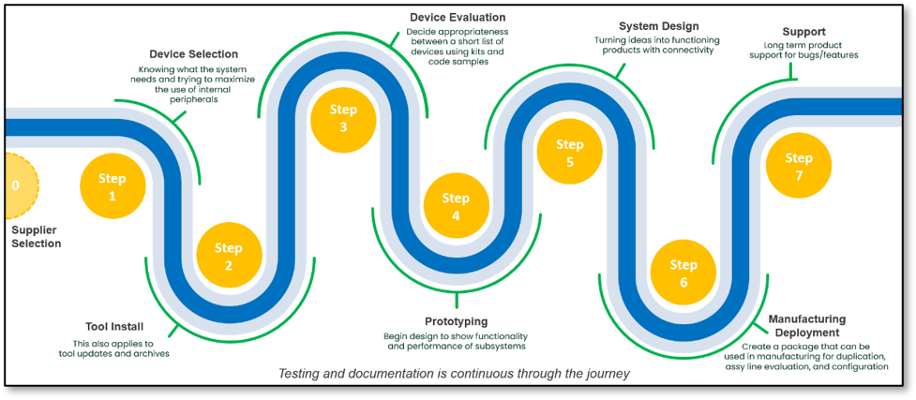
From idea to product, faster
The big opportunity for Xplore is helping developers carry more of their investment from one idea to the next. As requirements change, teams can use established hardware, software and development expertise without rebuilding the underlying development environment from the ground up. Combined with Arm's common compute foundation, this gives developers a more repeatable path from idea to prototype to product – leaving more time to exploring what differentiates their next great product.
Join us at electronica
Join Arm and Renesas at electronica in Hall C5, Stand 479, and explore hands-on demos of Xplore.

Re-use is only permitted for informational and non-commercial or personal use only.
