Rethinking humanoid control: How Menlo Research built Asimov’s real-time motion stack on Arm
Discover how Menlo Research runs humanoid robot control and AI inference on one Arm Linux system, coordinating 25 motors within a clear 5 ms control budget.
By Odin Shen

This blog is co-authored by Odin Shen, Principal Solutions Architect, Arm and Selim Arguel, Lead Robotics Engineer, at Menlo Research.
Humanoid robot control systems are often divided across two computers. A lower controller, typically based on an MCU or RTOS, handles motor communication and time-critical control. An upper controller runs Linux and supports perception, planning, and AI workloads.
This separation provides a clear timing and safety boundary. However, it also introduces another software environment, toolchain, and a communication boundary in the middle of the control path.
Menlo Research explored a different question with Asimov, its open-source reference humanoid:
Can policy inference, real-time control, safety, and telemetry share one Arm-based Linux system while preserving the timing guarantees required for robot motion?
The result is a complete lower controller running on a Radxa CM5 module with a Rockchip RK3588S processor. The system controls 25 motors, runs a neural locomotion policy on the CPU, processes IMU data, applies safety checks, and publishes telemetry. It does this without a separate motor-control MCU or a separate RTOS domain.
Asimov 1 in simulation and on hardware. Video courtesy of Menlo Research.
The sections below look at how Menlo distributes workloads across Arm CPU cores and measures motor communication against a five-millisecond control budget.
One Arm system for the lower controller
Asimov's lower controller runs several workloads with different rates and execution requirements:
- 25 brushless motors controlled over five CAN buses
- A 200 Hz motor-control loop
- 500 Hz IMU fusion
- 50 Hz ONNX policy inference on Arm CPU cores
- 100 Hz telemetry snapshots
- Safety checks applied before commands reach the motors
The platform uses an RK3588S with four Arm Cortex-A76 CPU cores and four Arm Cortex-A55 CPU cores. This heterogeneous CPU topology gives the controller enough compute for neural inference while also providing a practical way to isolate time-critical work.
The Arm processor supports every stage, from policy inference to physical motion.
The control budget is five milliseconds
A 200 Hz control loop begins a new cycle every five milliseconds. Within that period, the controller must:
- Poll all 25 motors across five CAN buses.
- Read the latest IMU state.
- Consume the latest valid output from the concurrently running 50 Hz policy-inference workload.
- Apply safety checks to the policy output and robot state.
- Send new position targets to the motors.
- Publish telemetry when required.
These workloads are not all executed serially on the control-loop core. Policy inference runs concurrently at 50 Hz on two dedicated Cortex-A76 cores, while the 200 Hz control loop uses the latest valid policy output available for each cycle. Motor communication consumes most of the budget. Each motor responds only after receiving a request, and the five CAN buses operate in parallel while motors on each bus are polled sequentially. Across the 147 complete cycles measured while Asimov was walking, motor communication took an average of 4.556 milliseconds. This included sending commands to all 25 motors and receiving their responses.
That leaves little room for unpredictable work. The remaining time cannot be consumed by memory allocation, blocking calls, page faults, or unexpected cross-core scheduling delays.
This constraint shapes the complete software architecture. Every operation in the critical path must have a known purpose, a measurable duration, and a defined failure response.
Using Arm big.LITTLE for workload isolation
Mobile systems often use big.LITTLE CPU designs to balance performance and energy efficiency. Asimov also uses the topology as an isolation mechanism.
The controller assigns work as follows:
- One Cortex-A76 core runs the 200 Hz control loop and handles CAN interrupts.
- Another Cortex-A76 core runs 500 Hz IMU fusion and handles the related I2C interrupt.
- Two Cortex-A76 cores run the ONNX Runtime intra-operation threads.
- The four Cortex-A55 cores handle Linux services, networking, and movable kernel housekeeping.
Critical threads use pthread_setaffinity_np() and do not migrate between cores. Movable kernel threads are kept away from the cores assigned to control and IMU processing. CAN and I2C interrupts are placed on the same cores as the threads that consume their data.
This reduces cross-core wake-ups and cache movement. More importantly, it gives the control path CPU time that other workloads cannot unexpectedly consume.
The approach demonstrates a useful capability of the Arm-based compute platform: AI inference, Linux services, sensor processing, and real-time control can use the same processor while retaining explicit workload boundaries inside the system.
Real-time behavior through standard Linux mechanisms on Arm
The controller uses PREEMPT_RT together with standard Linux scheduling and system controls. Menlo did not build a separate real-time framework or depend on custom vendor APIs for the control loop.
The configuration includes:
- SCHED_FIFO for critical threads
- CPU affinity for control, inference, and sensor processing
- IRQ affinity for CAN and IMU interrupts
- mlockall() to prevent page faults during operation
- The performance governor to avoid frequency-scaling latency
- Disabled real-time throttling for the isolated control workload in this test configuration
- clock_nanosleep() with absolute deadlines
Absolute deadlines prevent timing error from accumulating. If one cycle finishes late, the next cycle still targets its original scheduled time.
PREEMPT_RT also reduces the long tail of scheduling latency. In Menlo's testing, a stock Debian kernel could preempt a SCHED_FIFO thread for several milliseconds. That delay is large enough to create false motor timeouts in a five-millisecond loop. PREEMPT_RT reduced the worst-case scheduling delay to tens of microseconds in their test environment.
Kernel configuration alone does not remove every source of delay, so the CAN path retains a three-stage recovery mechanism:
- Poll each motor with a per-slot timeout.
- Retry while time remains in the current cycle.
- Drain all sockets with a final non-blocking read.
Together, these mechanisms reduce scheduling latency, detect late responses, and help limit the effect of a delayed transaction on the rest of the control cycle
Measured motor communication latency during walking
The test captured 154 motor I/O cycles while Asimov was walking under its normal operating configuration, with policy inference, IMU fusion, safety checks, and telemetry running concurrently. Of these, 147 cycles received responses from all 25 motors and form the basis of the latency statistics shown below.
Across the 147 complete cycles, the mean full communication time was 4.556 milliseconds. The p95 latency was 4.752 milliseconds, the p99 latency was 4.896 milliseconds, and the maximum observed latency was 4.912 milliseconds.
None of the 154 recorded motor I/O cycle durations exceeded the five-millisecond control period. Seven cycles remained incomplete after the retry and final non-blocking socket-drain mechanisms had run, so they were recorded as missed responses. Menlo notes that isolated, non-consecutive missed responses do not immediately interrupt policy execution. Consecutive misses trigger a safety fault that places the robot into its DAMP safe state. In this measured sample set, motor communication remained measurable and bounded by the five-millisecond control period, with incomplete responses detected and handled explicitly. These measurements cover motor communication only, not the execution time of the complete control stack.
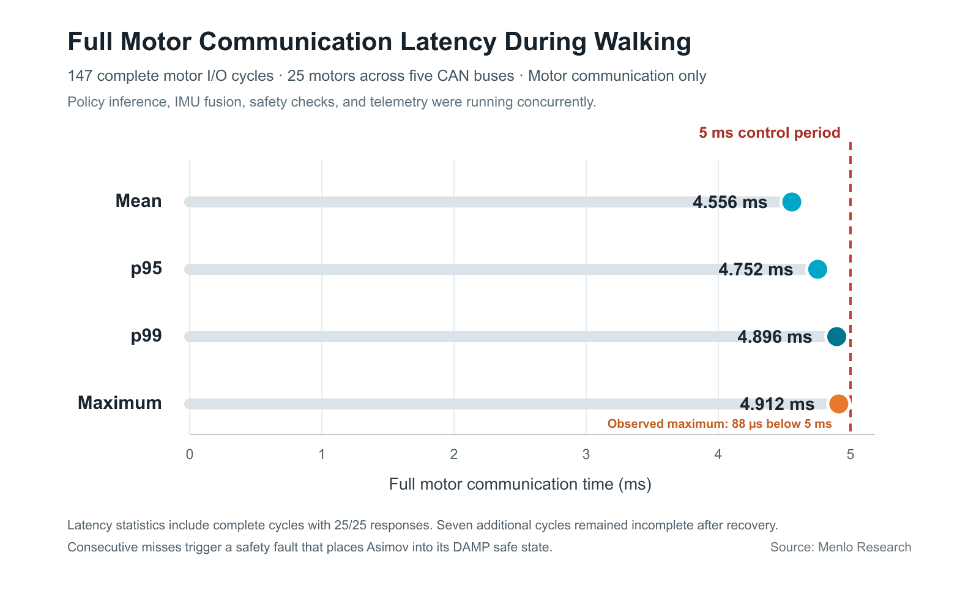
Chart showing full motor communication latency across 147 complete motor I/O cycles while Asimov was walking. Mean latency was 4.556 ms, p95 was 4.752 ms, p99 was 4.896 ms, and the maximum was 4.912 ms, compared with a 5 ms control period. Seven additional cycles remained incomplete after recovery.
Running the locomotion policy on the Arm CPU
The locomotion policy accepts 84 observation values and produces 25 joint targets every 20 milliseconds. It runs with a standard Linux AArch64 build of ONNX Runtime using the default CPU execution provider, two intra-operation threads, and MLAS NEON kernels.
Menlo deliberately chose the CPU path instead of the integrated NPU. The Arm CPU environment offered documented behavior and avoided introducing a vendor-specific driver and scheduling stack into the timing analysis.
The inference loop also avoids allocation. Input and output tensors are created once, and each execution copies data into the existing buffers before calling ONNX Runtime.
Every inference is timed. If execution exceeds 15 milliseconds, the controller discards the result and reuses the last valid action. If three consecutive results exceed the limit, the robot enters its damping state.
For physical AI, a late inference result must not cause a delayed physical action. The controller treats timing as part of result validity.
Safety in the same control cycle
Menlo implements these runtime protection checks within the same controller, using sensor data and policy outputs already available in the control cycle.
The checks include:
- Detecting a sudden command change across multiple joints before sending it over CAN
- Entering the damping state when tilt or angular velocity indicates a fall
- Applying a deadman timeout when operator commands stop
- Rejecting any policy output containing NaN or infinite values
These checks run before a command reaches a motor. The system therefore evaluates both the numerical validity of the policy output and whether the proposed motion is consistent with the robot's safety envelope.
This design does not establish a general safety architecture for every robot. It shows how tightly coupled safety checks can share the same Arm compute platform and control data when their execution time and failure behavior are included in the system budget.
One Arm development model from simulation to hardware
The common Arm architecture also simplifies how the controller is developed and tested.
Developers can build the AArch64 application on an Apple Silicon system and run it against five virtual CAN interfaces. MuJoCo emulates all 25 motors behind vcan0 through vcan4. The same binary can then run on the Radxa CM5 and communicate with the physical motors through can0 to can4.
The workflow does not require a separate cross-compiler, a flashing process, or a vendor-specific IDE. One binary and one artifact hash can represent both the simulated and physical controller.
This approach reduces differences between simulation and physical deployment. Developers can exercise bus behavior, control logic, safety paths, and policy integration before connecting the application to real motors.
The boundary still depends on the workload
Asimov's result applies to the lower controller. The policy observes joint positions and velocities, gravity, angular rates, and operator velocity commands. These inputs can be assembled quickly, and the neural network runs within the available CPU budget.
Vision changes the calculation. Camera workloads introduce far more data, larger models, and different latency requirements. Menlo therefore keeps perception and higher-level reasoning in a separate compute domain that can send velocity commands to the lower controller.
This limitation reinforces the central engineering principle. A robot does not need one universal compute boundary. Developers should place each workload where its deadline, compute demand, isolation requirement, and failure consequences can be handled explicitly.
Arm provides a common architectural foundation across those domains. The boundary can move without forcing every part of the robot into the same execution environment.
What Arm robotics developers can take from this design
The Asimov controller provides several practical lessons for developers building motion systems on Arm Linux:
- Start with the control deadline and account for every operation in the critical path.
- Reserve CPU cores for time-critical work and move Linux housekeeping elsewhere.
- Place interrupts close to the threads that consume the data.
- Remove allocation, page faults, and unbounded blocking from the control cycle.
- Measure every inference and communication operation.
- Treat a late AI result as an invalid result rather than a delayed command.
- Design recovery paths even after reducing worst-case scheduling latency.
- Consolidate workloads only when the resulting timing requirements remain measurable.
Final thoughts
Menlo’s work on Asimov shows a practical role for Arm in robot motion. One Arm-based Linux module executes the locomotion policy, processes sensor feedback, enforces safety checks, and closes a 200 Hz control loop across 25 motors.
The result does not depend on hiding the complexity behind a claim of deterministic Linux. It depends on assigning resources deliberately, instrumenting and measuring the critical operations in the control path, and defining what happens when an operation is late or invalid. This approach shows how measurable deadlines and explicit failure response can support reliable real-time control.
By positioning Asimov as an open reference platform, Menlo aims to reduce dependence on proprietary embedded firmware for the wider robotics ecosystem. Small and medium-sized teams can use off-the-shelf Arm compute and Linux to build real-time humanoid motion systems around measurable deadlines and bounded failure behavior, without having to reinvent complex multi-controller architectures.
Menlo Research will continue to share more technical milestones, architectural deep-dives, and open-source updates as they push the Asimov stack forward.
For Arm developers, this expands the role of the platform beyond application processing or high-level AI inference. Arm can serve as the foundational compute architecture that bridges high-level policy inference with timely, measurable physical motion.

By Odin Shen
Re-use is only permitted for informational and non-commercial or personal use only.
