Arm Toolchain for Linux 22.1 release
ATfL replaces ACfL with an LLVM-based toolchain, delivering optimized performance for AI, HPC, and cloud workloads on Arm platforms

It has been one year since we released the Arm Toolchain for Linux (ATfL). It introduces a modern Fortran compiler based on a new Fortran frontend. It is our pleasure to announce the availability of ATfL version 22.1.
In this blog post, we revisit the role of ATfL and look at the new features and fixes introduced in ATfL 22.1.
Introduction: What is ATfL?
Arm Toolchain for Linux is an open-source compiler suite for AArch64 that is built on the LLVM ecosystem. As Arm technology adoption increases across data centers and cloud platforms, developers needed a reliable and high-performance LLVM-based compiler suite for scientific computing, AI, and cloud-native workloads. The Arm Toolchain for Linux is optimized for Arm Neoverse cores and addresses this need. It replaces the older Arm Compiler for Linux (ACfL), which is a downstream LLVM fork, with a toolchain that follows upstream LLVM development. This toolchain supports modern language features and improves compilation on Arm platforms.
What is new in Arm Toolchain for Linux 22.1?
Here are some new features and updates from the version 22.1 release:
- The base compiler technology to LLVM 22.1 (from LLVM 21) is updated to enable performance and stability improvements.
- Non-standard rtc Fortran intrinsic implemented as an alias for time.
- threadprivate common block variables appearing in equivalence in a Fortran/OpenMP code are allowed.
- The Arm Toolchains package repositories are also transitioning to a new and improved structure. Users who have previously installed using the native package manager can update to ATfL 22.1.0 automatically. New users must follow the updated instructions in the Installation.md file (Documented on developer here).
Here are additional differences between upstream LLVM and ATfL introduced in previous releases:
- The compiler uses a config file by default, which improves performance-specific optimizations; most notably, it encourages the use of the vectorized mathematical routines in the Loop Vectorizer which enables the possibility of vectorizing loops containing the calls to the mathematical library functions.
- The Bash autocompletion has been extended to cover armclang, armclang++ and armflang.
- The Amazon Linux target triple is properly recognized, which enables vectorizations of the pieces of code calling the sincos* functions.
Based on upstream LLVM 22.1, ATfL benefits from the latest Arm ecosystem contributions from the Arm developer community and optimizations from our team:
- The support for the latest Arm-based devices, including the Ampere1C cores.
- Support for latest architecture extensions:
- Assembler/disassembler support has been added for Armv9.7-A (2025) architecture extensions. More details about the Armv9.7-A can be found in this blog post: Arm A-Profile Architecture developments 2025.
- Assembler/disassembler support has been added for ‘Virtual Tagging Extension (vMTE)’ and ‘Permission Overlay Extension version 2 (POE2)’ Future Architecture Technologies extensions.
- BOLT
- Added support for lite mode on AArch64. It can be enabled with -lite=1. When used, BOLT avoids duplicating cold code by reusing the original code, which reduces output binary size.
- Documentation about BOLT and its usage on Arm platforms is available via our learning paths and user guides:
Please read the release notes of LLVM 22.1 release for the full list of changes: LLVM 22.1.0 Release Notes — LLVM 22.1.0 documentation.
You can also find more details with technical deep dives in our recent blog post here.
The functionality gap between Arm Toolchain for Linux and the last Arm Compiler for Linux version is now addressed. Several directives are now supported in both ATfL and upstream LLVM:
- New Fortran directives supported by armflang: vector vectorlength, prefetch, inline, forceinline, noinline.
ATfL 22.1 performance
We measured and tracked the performance of a set of HPC codes, benchmarks, test cases, and mini-apps across compiler versions on Arm Neoverse. The bar chart below shows performance when you use Arm Toolchain for Linux 22.1 compared with Arm Compiler for Linux 24.10.
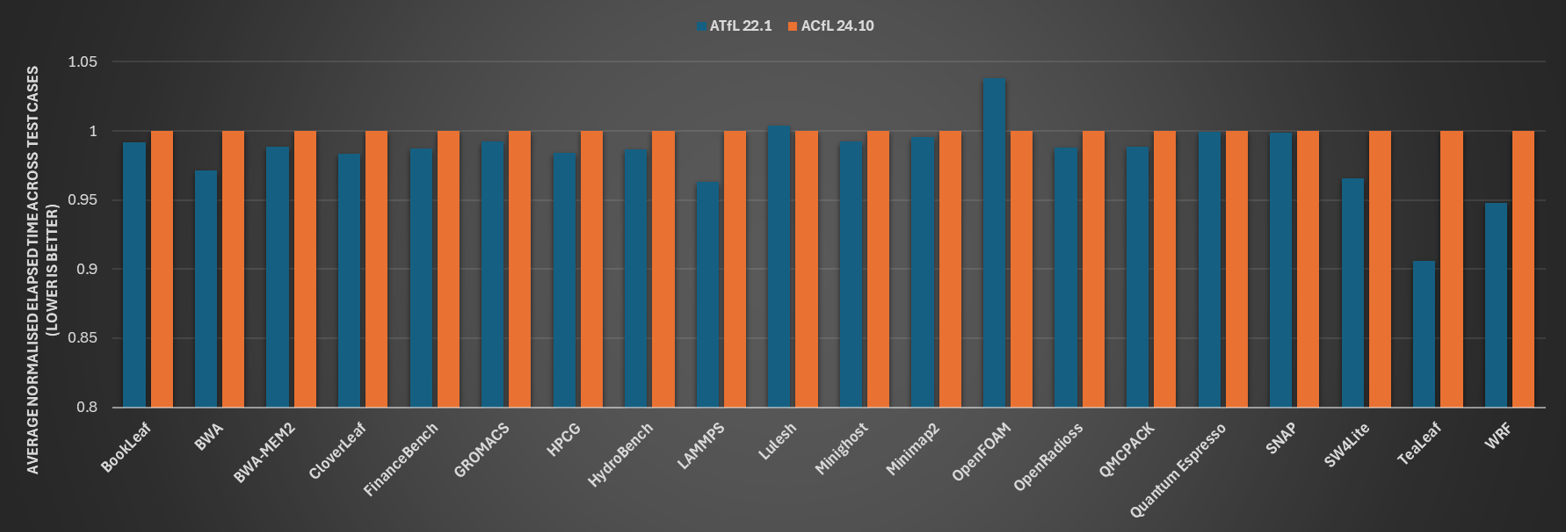
Results show that ATfL 22.1 delivers performance that is comparable to ACfL 24.10. In most cases, it improves performance by an average of 2% across workloads. The only noticeable performance regression we encountered is on OpenFOAM. We continue to optimize the performance of LLVM for cloud, AI, HPC, and scientific workloads. The next ATfL release to improve OpenFOAM performance is expected later this year.
End of life for Arm Compiler for Linux
The Arm Toolchain for Linux replaces Arm Compiler for Linux. ACfL is no longer supported by Arm. This is highlighted in the release blog post. ATfL introduces a modern LLVM-based Fortran compiler that supports collaboration across ecosystems.
With the release of ATfL 22.1, the Arm Toolchain for Linux has reached a level of maturity, stability, and performance that enables us to recommend that ACfL users migrate to ATfL when practical.
How to start: Documentation & installation
Here are some resources to get started on your ATfL journey:
Arm Toolchain for Linux User Guide
For installation instructions, see the Installation section.
If you have been using the Arm Compiler for Linux, the ACfL to ATfL porting guide section provides guidance to support migration.
When is the next release?
We follow a two-release-per-year cadence. The next ATfL version will follow the release of LLVM 23 in about six months.
Naming convention change
ACfL version 24.10 is the final release and ATfL version 22.1 is the current release. This might raise questions about the naming convention.
We have changed our versioning method. Arm Compiler for Linux uses a version number that was based on the year of the release and the month. Arm Toolchain for Linux uses a version number based on the LLVM version.
Summary
With version 22.1, the Arm Toolchain for Linux is now the go-to LLVM-based compiler suite, It provides highly optimized performance for scientific computing, AI, and cloud-native services on Arm-based platforms.
Start using ATfL today to benefit from the latest improvements.

Re-use is only permitted for informational and non-commercial or personal use only.
