Elasticsearch on Arm Neoverse-based AWS Graviton5 processors: Up to 48% higher throughput and 53% lower latency for agentic AI applications
Learn how Elasticsearch on AWS Graviton5 delivers a strong balance of query throughput, median latency, tail latency and indexing performance.
By Sameer Nori

This blog post is co-authored by Sameer Nori, Sr. Manager, Software Ecosystem, Arm; Pranay Bakre, Principal Solutions Engineer, Arm; and Jason Bryan, Principal Software Engineer, Elastic.
During the last few years, Arm Neoverse-based compute platforms have become the mainstream foundation for Cloud and AI infrastructure, delivering high performance and energy-efficient compute at scale. In 2025 Arm announced that more than 50% of compute shipped to the world’s top hyperscalers is Arm-based, reflecting a significant shift from legacy x86 architectures to modern Arm platforms in data centers. As Arm adoption and migration have accelerated, developers have increasingly built and deployed applications natively on Arm running a broad range of cloud-native applications, AI frameworks, databases and analytics platforms with minimal or no code changes to achieve the platform benefits.
To help customers realize these benefits, Arm works closely with cloud providers, software vendors and the open-source community to enable and optimize widely deployed cloud workloads for Arm-based platforms. Through initiatives such as Arm Cloud Migration, Arm helps customers and partners validate, optimize and migrate production applications.
Elastic on Arm
Elastic is a single, unified platform built on Elasticsearch that lets organizations search, observe, and secure all their data in real time, giving AI agents the context they need to reason and act.Elasticsearch supports Arm across AWS, Microsoft Azure, and Google Cloud, enabling Elasticsearch workloads on AWS Graviton, Azure Cobalt, and Google Axion Arm- based processors. The platform enables a wide variety of workloads including enterprise search, observability dashboards, geospatial applications, retrieval-augmented generation (RAG), and the search layer behind agentic AI applications.
In this blog, we will showcase performance benchmarks that show Elasticsearch running on AWS Graviton5 delivering consistently lower latency than an equivalent Intel Xeon 6 (Granite Rapids) across all three Elasticsearch tracks, with reductions ranging from 31.7% to 53.8% across P50, P90, and P99 measurements.
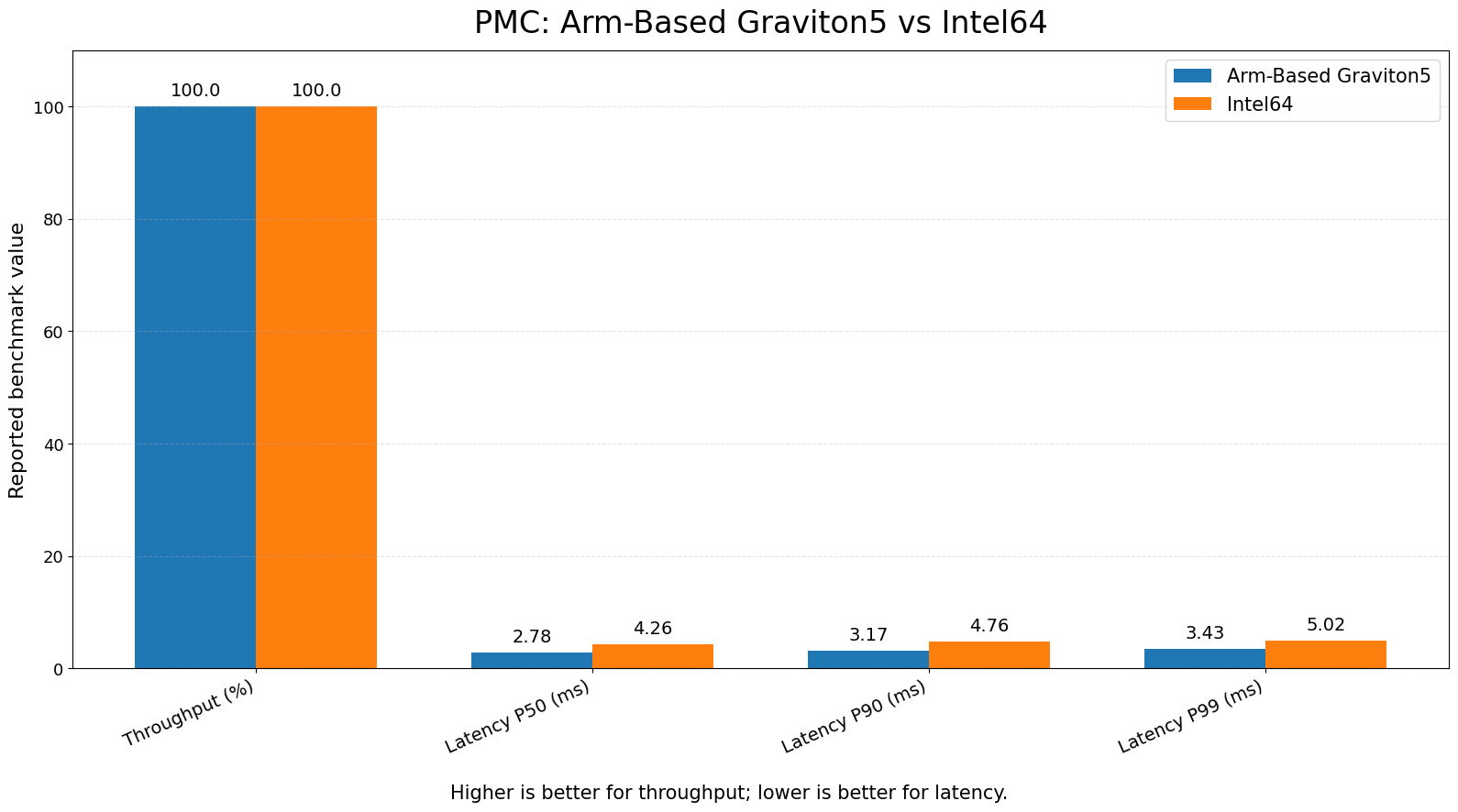
PMC: Throughput is constrained by the target rate and set at 100%
Benchmarking methodology and configurations
ESRally provides a repeatable way to compare Elasticsearch workload behavior across architectures. In this evaluation, the selected ESRally “tracks” used represented three common Elastic workload types that also map to agentic application needs: geospatial context, operational telemetry, and full-text document retrieval.
- Geopoint evaluates geospatial search and analytics patterns that can support location-aware agents, logistics assistants, field-service routing, and map-based decision workflows.
- HTTP Logs represents observability and operational analytics workloads that can support incident-response agents, SRE copilots, security investigation assistants, and automated troubleshooting workflows.
- PMC stresses full-text search and document-oriented indexing behavior that can support enterprise knowledge assistants, RAG systems, support copilots, and policy-aware agents.
|
Component |
Configuration |
|
Elasticsearch |
9.3.0 |
|
ESRally |
2.13.0 |
|
Java |
OpenJDK 21 |
|
Operating System |
Ubuntu 24.04 LTS |
|
Instance types |
Intel: m8id.16xlarge Graviton5: m9gd.16xlarge |
|
Workloads |
Geopoint, HTTP Logs, PMC |
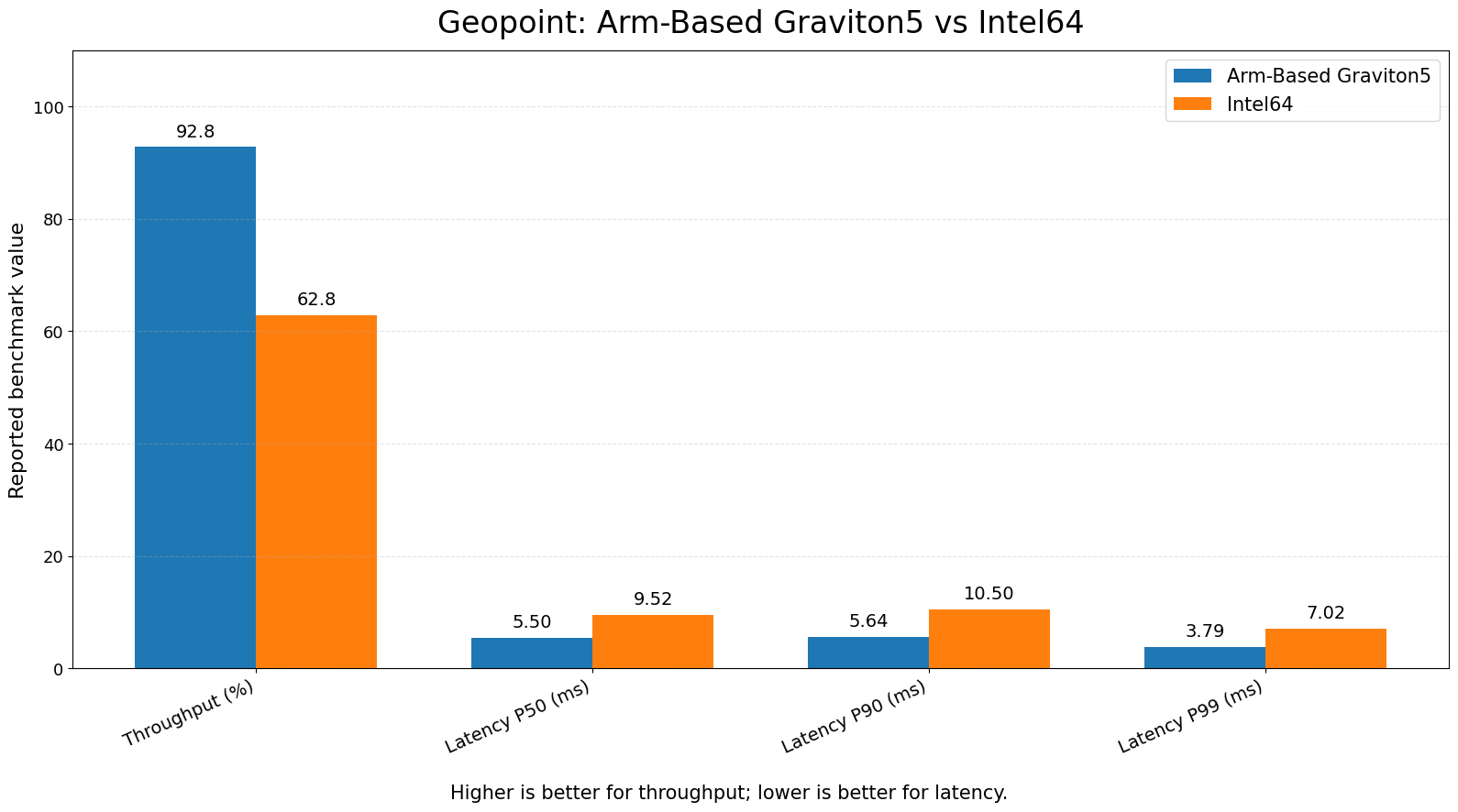
Geopoint: Geospatial search and analytics
The Geopoint track focuses on geospatial search workloads, covering operations such as polygon containment, bounding-box queries, distance filters, geo-distance sorting, and aggregations. These are representative of applications that rely on location-aware search and analytics.
Graviton5 delivered the highest overall query performance across the Geopoint benchmark, outperforming the x86 baseline on 36 of the 58 variable-throughput tasks and achieving up to 48% higher throughput on aggregate across the workload.
|
Metric |
x86 baseline |
Graviton5 |
Graviton5 advantage vs .x86 |
|
Throughput (%) |
62.8 |
92.8 |
48% higher throughput |
|
P50 latency |
9.52 ms |
5.50 ms |
42% lower latency |
|
P90 latency |
10.5 ms |
5.64 ms |
46% lower latency |
Elasticsearch on Arm performs well when the workload is dominated by compute-heavy query execution.
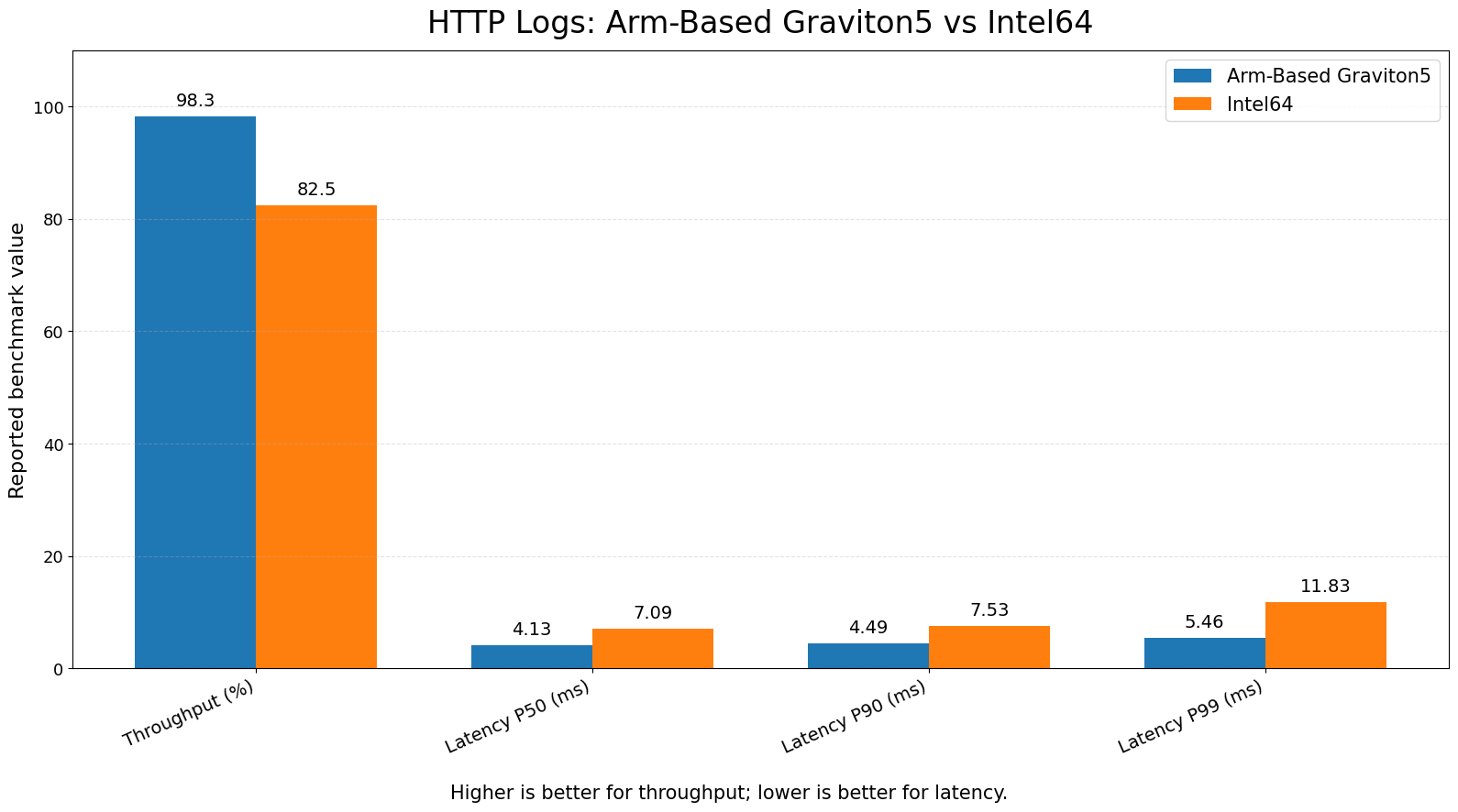
HTTP Logs: Lower query latency
The HTTP Logs benchmark represents a common ES deployment scenario. Organizations depend on log analytics for observability, security analytics, SIEM workflows, infrastructure monitoring, application performance monitoring, and centralized operational troubleshooting.
Unlike Geopoint, HTTP Logs combine continuous indexing with large volumes of filtering, sorting, scrolling, and aggregation queries. Among the workloads evaluated, it produced the largest architectural separation.
|
Metric |
x86 baseline |
Graviton5 |
Graviton5 advantage vs. x86 |
|
P50 latency |
7.09 ms |
4.13 ms |
41.7% lower latency |
|
P90 latency |
7.53 ms |
4.49 ms |
40.3 % lower latency |
|
P99 latency |
11.83 ms |
5.46 ms |
53.8 % lower latency |
Graviton5 consistently delivered lower query latency. For production observability platforms, operational dashboards and agentic troubleshooting loops. These improvements can translate directly into better user experience or fewer instances required to meet the same service level. For production Elastic deployments focused on dashboards, alert investigation, search responsiveness, operational analytics, and agentic troubleshooting loops, these improvements can translate directly into better user experience or fewer instances required to meet the same service level.
PMC: Full-text search and document retrieval
The PMC track represents full-text search and document retrieval workloads commonly found in enterprise knowledge bases, documentation portals, and RAG applications. Unlike the other tracks, many PMC operations are intentionally executed at fixed request rates, making query latency a more meaningful measure of user experience than maximum throughput.
Graviton5 delivered lower P50, P90, and P99 query latency across the PMC benchmark, demonstrating its ability to consistently respond faster in interactive search workloads.
For applications that rely on responsive document retrieval, such as enterprise search, knowledge bases, customer support, and RAG systems; P90 and P99 latency are often a better indicator of user experience than aggregate throughput.
|
Metric |
x86 baseline |
Graviton5 |
Graviton5 advantage vs. x86 |
|
P50 latency |
4.26 ms |
2.78 ms |
34.7% lower latency |
|
P90 latency |
4.76 ms |
3.17 ms |
33.4% lower latency |
|
P99 latency |
5.02 ms |
3.43 ms |
31.6% lower latency |
Price performance completes the picture
Performance benchmarks alone don’t tell the complete story. Elasticsearch clusters often run continuously, so even modest differences in hourly instance cost can compound into meaningful savings over months or years. This is especially true for production environments with multiple data tiers, replicas, hot-warm architectures, or dedicated coordinating nodes. At scale, lower infrastructure costs can reduce the total cost of operating the cluster, create additional budget for capacity growth, and improve the economics of retaining larger datasets.
Graviton5’s lower AWS instance cost relative to comparable x86 configurations adds to the performance gains demonstrated across all three tracks. The combination of lower latency, higher throughput, and reduced compute spend means organizations may be able to meet performance objectives with fewer resources or achieve greater workload capacity within the same infrastructure budget. Across the three tracks, Graviton5 provides the most consistent balance of query throughput, median latency, tail latency, indexing performance, and overall cost efficiency.
Elasticsearch is well suited for AGI CPU agentic applications
AI agents are only as effective as the information they can retrieve. Unlike traditional RAG applications, agents repeatedly search for context, invoke tools, evaluate intermediate results, and refine their next steps before completing a task. In this workflow, search is not just a supporting feature, it is a critical part of the agent's reasoning loop. This makes Elasticsearch not just a search backend but a context engineering platform - unifying unstructured enterprise data, retrieving what matters, exposing it through tools, and governing it safely — for enterprise search, RAG, and agentic AI applications.
Future plans will explore extending this work to enable Elasticsearch on the Arm AGI CPU, providing insight into how Arm Neoverse-based platforms in modern AI data centers can support the next generation of agentic AI applications.
For organizations planning new Elastic deployments—or evaluating whether to migrate existing Elasticsearch clusters to Arm—the combination of benchmark performance and price-performance analysis provides a stronger basis for infrastructure decisions than throughput alone. The best outcomes come from testing representative workloads, validating operational compatibility, and matching Arm-based infrastructure to the production demands.
The Arm Cloud Migration program offers expert guidance, proven best practices, and technical resources to ensure successful adoption of the Arm platform and we encourage you to reach out and engage with us.
Arm Cloud Migration program Connect with an Arm Cloud Migration expert

By Sameer Nori
Re-use is only permitted for informational and non-commercial or personal use only.
