Vital progress: Medical-grade wearables
UT Austin have developed ultra-thin e-tattoos using Arm-enabled weightless neural networks for low-power, on-device analysis of vital signs in medical-grade wearables
By Becky Ellis
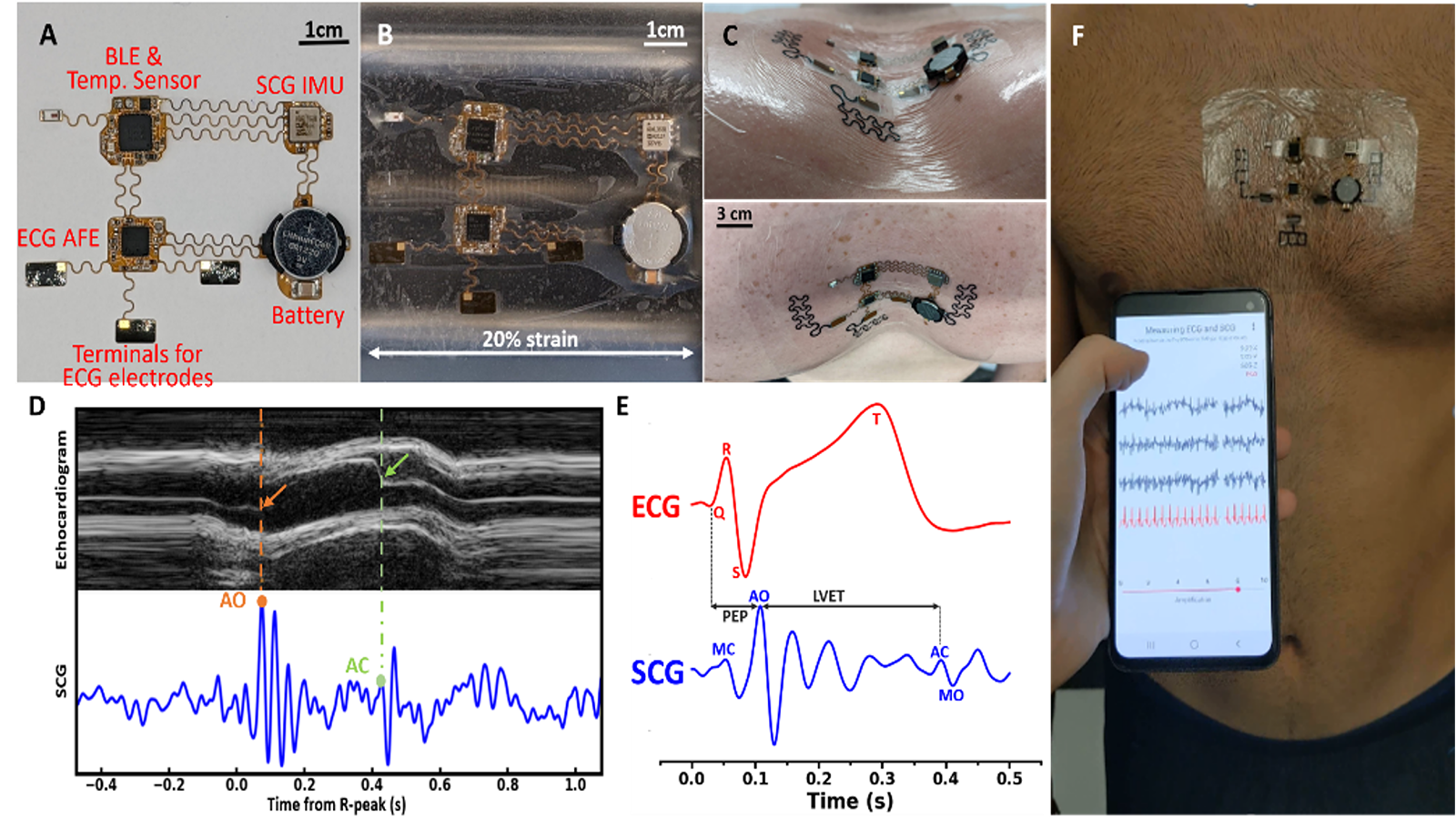
In early 2024, Professor Lizy Kurian John’s group at the University of Texas at Austin sought a practical use for its Arm-enabled weightless neural network. Meanwhile, Professor Nanshu Lu’s team spent over a decade working on e-tattoos. These are non-invasive, skin-conformed patches for monitoring the body’s vital signs. An email brought the two projects together, and the collaboration proved transformative.
Professor Nanshu Lu, Carol Cockrell Curran Chair in Engineering at the University of Texas at Austin, developed a brilliant concept. Her group spent 14 years developing the e-tattoo. It is an ultra-thin, wearable, removable patch that could monitor the body’s vital signals and physiological signals. When paired with advanced data fusion and modelling, it can offer an alternative to invasive or labour-intensive methods. These methods measure critical parameters such as mental workload or stroke volume, which is the amount of blood pumped per heartbeat.
However, Professor Lu’s team faced a major challenge. To make that information clinically relevant, they had to continuously transmit the raw data being generated to a smart phone or tablet for analysis. This approach required high-power compute. As a result, the e-tattoo relied on bulky batteries.
“Using wearables to give a medical-grade inference or prediction is the holy grail that faces major roadblocks,” Professor Lu explains. “We developed a rudimentary machine learning model to show that, with the help of machine learning and neural networks, it would be feasible to predict clinically relevant parameters when provided with high quality data acquired by the e-tattoo. But we had to use computers to post-process the signal, train the model, and make inference. We never thought it would be possible to run neural networks on the e-tattoo itself.”
This is where Professor Lizy Kurian John comes in. Professor John is the Truchard Foundation Chair in Engineering at the University of Texas at Austin. Her group developed a new type of weightless neural network (WNN). This is a small and highly efficient form of compute that can run on edge devices.
“I was looking for that killer application where we could put it, and where it would be useful.”
“For smaller data sets and smaller applications, we could prove very high accuracy with an extremely low energy and hardware requirement,” says Professor John. “I was looking for that killer application where we could put it, and where it would be useful.”
A new world of efficiency
Neural networks have become common, thanks to increasingly prominent tools like ChatGPT and other large language models. These deep neural networks rely on multiplications and additions. These processes are energy-hungry and expensive computationally. Very deep neural networks may be multiplying or adding across more than 100 layers of neurons.
The WNN does not rely on traditional weighted connections between neurons. There are no weights and there are no multiplications. The weightless neural network learns a logic function rather than an arithmetic function and stores it in a lookup table.
A lookup table with two inputs has four memory cells and can express 16 functions. A lookup table with four inputs has 16 cells and can express 65,536 functions. This large expressiveness, combined with the team’s recent advances in training them, enables neural networks with only a few layers of neurons. Especially for edge applications. This, says Professor John, offers a “very different level of efficiency”.
In early 2024, Professor John received an email about an upcoming webinar hosted by Professor Lu. This was her first encounter with the e-tattoo. Had she found her “killer application”? The place where her innovation could be of practical use? “Our technology could potentially run on the e-tattoo itself and enable low-power, real-time inference of the critical metrics – making it possible to monitor cognitive and cardiovascular states continuously without relying on bulky equipment or offline computation,” she says.
“We had the accuracy. We had the small footprint and very low energy consumption, so we could integrate the machine learning models into the sensor. That was all critical, because it enables you to process it right there on the patch. And because the battery can last longer, you can stick the e-tattoo to someone's chest and continuously monitor signals – from the heart, for example – for a longer time.”
She sent Professor Lu a message. “We were so excited,” says Professor Lu, on receiving that note. “Oh, thank God, I thought. This could open up a large window for the future.”
For the past 18 months, the two professors and their respective students have met weekly to further the collaboration.
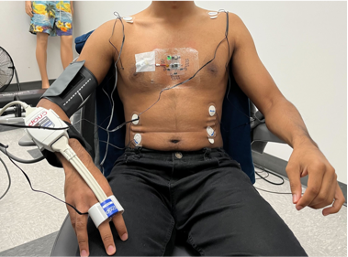
Figure 1: E-tattoos enable you to integrate machine learning on the sensor patch and continuously monitor signals on the chest for longer periods of time (image supplied by the author)
Brainwork
The e-tattoo has many potential use cases. For example, one use case is decoding mental workloads. “When the likes of air traffic controllers or aviators are experiencing a very high-stake, high-demand workload, the brain signal is quite complex,” says Professor Lu. “Brain signals happen at a much higher frequency and look much more random than heart beats. To monitor the brain, you need a lot of channels distributed across it. That is a huge amount of data. And we can save a significant amount of power.”
"Arm’s IP has played a key role in the ongoing e-tattoo project. Prof Lu’s original work was powered by a chip using an Arm Cortex-M4 microcontroller. She explains how Arm’s IP serves a dual purpose – it’s very capable and low power, and has a deep sleep mode that can save even more energy."
Merging the two projects has presented some challenges. One key challenge is the high accuracy needed in the medical world. “We are still working very hard to meet the ultimate benchmark of gold standard medical devices,” says Professor Lu. “This is very stringent. Given how small the weightless neural network is, it is almost a miracle that we are able to achieve an error range of 10-12%. But we are pushing hard to reduce those errors even further.” Professor John concurs that the bar is very high – especially for her team, for whom the peculiarities of medical research are all new.
“We need to leverage the microcontroller for edge synchronisation of separate electrical, mechanical, and optical sensors to the same controller, and then package it together for transmission. The Arm microcontroller is very versatile and does that very well.”
“In medical research you have human subjects,” says Professor John. “My students have to understand their constraints. We have to test our neural network models with new patients and see whether they work. We constantly strive to improve them, learning what we should do in order to get a model that applies in every situation. That's a very high bar for people in machine learning.”
Adapting the design
Arm IP plays a key role in the ongoing e-tattoo project. Professor Lu’s original work was powered by a chip using an Arm Cortex-M4 microcontroller. She explains how Arm IP serves two purposes:
- It is very capable and low power.
- It has a deep sleep mode that can save even more energy.
However, there was more.
“We also need to leverage the microcontroller for edge synchronization of separate electrical, mechanical and optical sensors to the same controller, and then package it together for transmission,” she says. “The Arm microcontroller is very versatile and does that very well.”
The teams soon found that the Arm microcontroller could also help them change their machine learning models more quickly. Professor John’s team had been making hardware accelerators, which are tiny chips of their own, instead of running them on a software model. The collaboration with Professor Lu's group led to the creation of small WNN models that can fit inside the limited memory of the e-tattoo. This provided flexibility to change the models quickly and personalize them for each patient.
“In the future, we want to monitor the full brain. For example, we want to measure trust between humans and AI. This is a huge area where we can expand.”
Her students then adapted the design. They created a neural network model that fit within size constraints and reorganizes the data.“ In a normal processor, people deal with 8-bit, 16-bit, or 32-bit integers,” Professor John explains. “In the new weightless neural networks, we deal with a lot of binary information, and it is only 1 bit wide. A zero or one, that is it. But if we put 1 bit in a 32-bit integer space, we are wasting 31 out of 32 bits. We had to do some clever tricks to pack the data efficiently.“ But the students are smart enough to figure it out. Engineers always say, ‘Ok, this is all we have. How do we make it work?”
Professor John praises Arm’s quality as a collaborator. Several members of her group have interned or worked at Arm. The company has also supported some of her past research, including funding students and providing tools for her other work in computer architecture. Professor John has co-authored published papers with Arm. The company is also collaborating on a current project, where it provides guidance for her group’s proposal.
“I want to thank Arm for the different kinds of support over the years,” she says.
Sparking new ideas
Looking ahead, Professor John is keen to explore the possibility of applying the WNN to larger applications, even in the cloud and on servers. The e-tattoo alone offers plenty of scope for greater innovation.
“I currently do not see any kind of edge computing that is successful at monitoring the brain,” says Professor Lu. “In the future, we want to monitor the full brain. We want to measure not just the mental workload but, for example, trust between humans and AI. This is a huge area where we can expand.”
The e-tattoo story shows how the smallest actions, such as clicking on an email, can spark game-changing collaborations. It also shows the power of interdisciplinary research. With the e-tattoo, each group has been able to offer invaluable help to the other, while seeing their own work propelled towards real-world practical application. Professor John concludes: “When you cross the domains, a lot of interesting things can happen.”
|
|
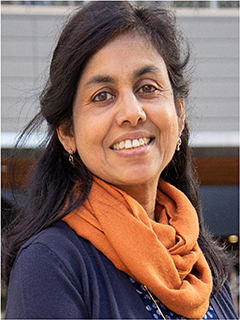
Professor Lizy Kurian John holds the Truchard Foundation Chair in Engineering in the Chandra Family Department of Electrical & Computer Engineering at The University of Texas at Austin. |
|
|
Professor Nanshu Lu holds the Carol Cockrell Curran Chair in Engineering at The University of Texas at Austin. |

Arm offers a range of IP and tools at no charge for academic research use, including the Arm Academic Access and Arm Academic Quickstart programs. To learn more about available IP, please visit our Explore Research Enablement page.
Arm provides free educational materials for academics, students, and aspiring engineers to teach, learn and develop on Arm. Please visit the Arm Education site to learn more.

By Becky Ellis
Re-use is only permitted for informational and non-commercial or personal use only.
