Why vector databases matter for agentic AI
Explore the role of vector databases in agentic AI applications and how Arm Neoverse platforms deliver the performance and efficiency needed to support AI retrieval workloads at scale
By Sameer Nori

This blog post is co-authored by Sameer Nori, Ashok Bhat, and Koray Ozkal
Agentic AI systems are reshaping how enterprises deploy AI applications. Unlike traditional AI systems, agentic workflows can reason across multiple steps, retrieve external knowledge, invoke tools, and maintain contextual awareness while executing tasks.
At the center of agentic compute is a critical infrastructure layer: the vector database.
The global vector database market is projected to grow from $2.65 billion in 2025 to nearly $9 billion by 2030, representing a 27.5% compound annual growth rate (CAGR), according to MarketsandMarkets. This growth is driven by increasing enterprise adoption of generative AI, retrieval-augmented generation (RAG), semantic search, and multimodal AI applications. As enterprises adopt agentic AI, vector databases are becoming foundational infrastructure for storing and retrieving the contextual knowledge AI agents depend on.
Why vectors matter
Traditional databases are optimized for exact-match queries and structured data. AI applications operate differently. Modern AI systems search for semantic meaning and contextual similarity rather than exact keywords.
In AI systems, text, images, audio, and video are converted into embeddings, high-dimensional numerical representations commonly referred to as vectors. These vectors capture semantic relationships between pieces of information. This enables AI systems to retrieve contextually relevant results even when exact matches do not exist.
Vector databases are specialized systems designed to efficiently store, index, and query these embeddings at scale. They power the retrieval layer behind RAG systems and increasingly support agentic AI workflows where AI agents continuously retrieve and reason over enterprise knowledge.
The vector database pipeline typically consists of three stages:
- Indexing: Organizing vector data into optimized structures for fast similarity search
- Querying: Converting prompts into embeddings and retrieving the nearest semantic matches
- Post-processing and reranking: Filtering and refining results to improve contextual accuracy before passing them to downstream models
Understanding vector indexing algorithms
Efficient vector search requires balancing three key factors: search accuracy, query latency, and memory efficiency. To search across millions or billions of embeddings, vector databases rely on approximate nearest neighbor (ANN) indexing algorithms.
Three of the most common approaches include:
- Flat Index: Flat indexing performs a comparison between a query vector and every vector in the database. While computationally intensive, it provides the highest accuracy and works well for smaller datasets or precision-sensitive applications.
- Inverted File Index (IVF): IVF partitions vectors into clusters, reducing the search space by scanning only the most relevant partitions instead of the entire database. The nearest cluster is found and searched. This improves performance while maintaining improved accuracy compared to the flat index. IVF can also be combined with product quantization to save memory but this can slightly reduce accuracy.
- Hierarchical Navigable Small World (HNSW): HNSW builds a hierarchical graph structure with an upper layer for long-range express connections and a lower layer for dense local connectivity. This structure enables extremely fast and accurate similarity search at large scale. HNSW has become one of the most widely adopted indexing approaches for production vector search deployments.
The optimal indexing strategy depends on workload requirements and tradeoffs between accuracy, latency, and infrastructure cost.
Powering vector databases with Arm Neoverse
Vector databases are highly parallel, memory-intensive workloads that benefit from efficient CPU architectures. While GPUs often accelerate model training and portions of inference, CPUs remain critical for vector indexing, retrieval orchestration, metadata filtering, reranking, and distributed coordination.
Arm Neoverse platforms are well suited for these retrieval-heavy AI pipelines, combining high core scalability, strong memory throughput, and efficient SIMD acceleration for vector operations. Several vector databases and open-source vector libraries already support customers with deployment on Arm. These include OpenSearch, Elasticsearch, Qdrant, Weaviate, Microsoft DiskANN and Google ScaNN, among others.
Building on the Arm Neoverse foundation, Arm AGI CPU is purpose-built for the highly concurrent, memory-intensive workloads emerging with agentic AI. With high-performance Neoverse V3 cores, substantial memory bandwidth per core, and high-speed I/O, Arm AGI CPU is designed to support demanding retrieval workloads, including vector search.
Arm Neoverse Performance in Vector Search
In an independent performance evaluation by Signal65, Arm AGI CPU delivered 1.54x the modeled Milvus vector-search performance per rack compared with AMD EPYC 9755. The results showcase how Arm AGI CPU's combination of processor performance and rack-level compute density can significantly benefit vector database deployments.
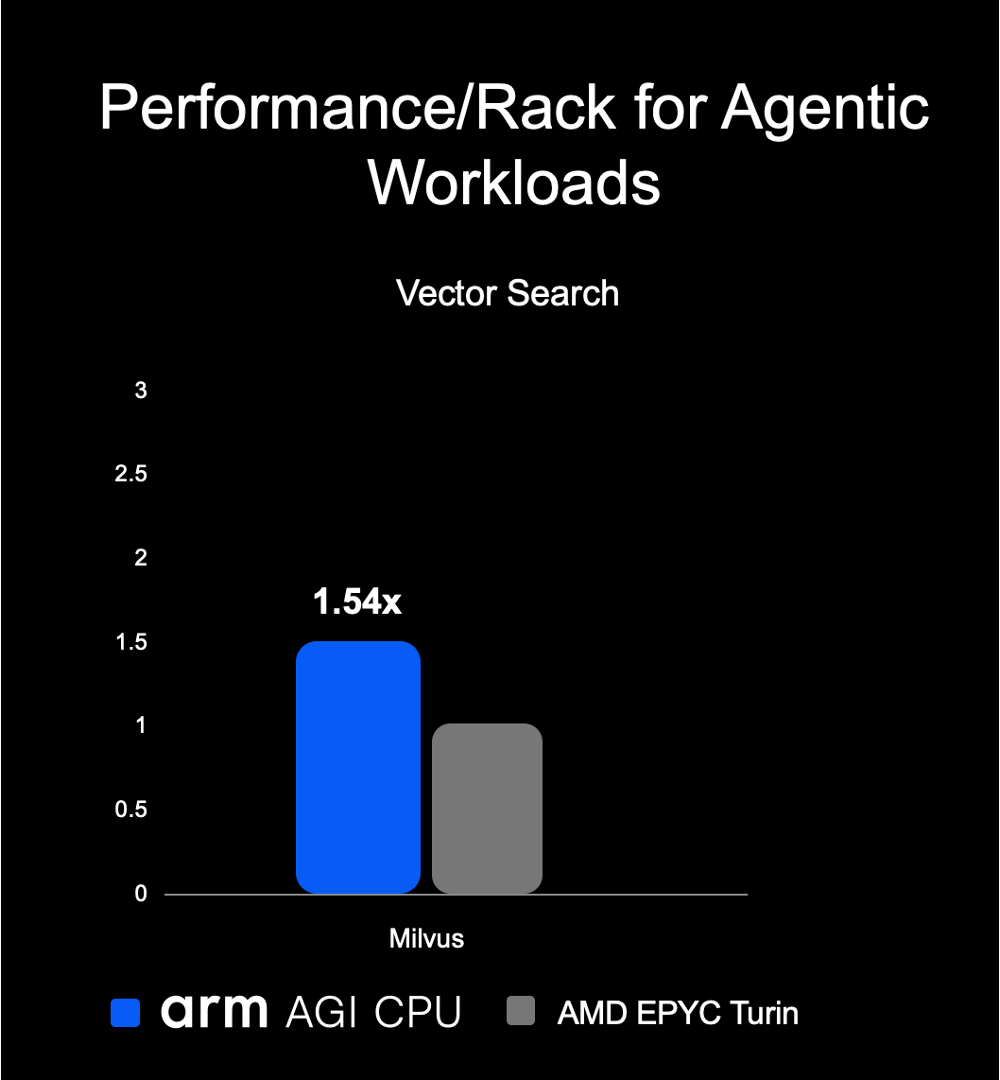
Figure 1: Arm AGI CPU outperforms AMD EPYC Turin 9755 for running Milvus.
Recent benchmarking of Redis 8.10.1 vector search also demonstrated AWS Graviton5 serving 16% more context fetches per dollar than x86 on the small dataset (570K documents, normal load) On the large dataset (3.3M documents, overloaded), it served 27% more. Graviton5 also delivered up to 34% lower p99 latency versus Intel Xeon 6. The instances used in these tests were M9g.2xlarge and M8i.2xlarge.
Zilliz, the company behind the open-source vector database Milvus and Zilliz Cloud, optimized its platform on Arm-based AWS Graviton3 processors to improve large-scale AI search and retrieval performance.
By migrating from x86-based instances to AWS Graviton3 processors, Zilliz achieved:
- 50% faster vector indexing, enabling faster data processing for billion-scale vector databases.
- 20% higher performance for running Milvus, resulting in faster queries for applications relying on quick vector search and retrieval.
- 10% lower infrastructure costs, translating into significant savings.
Migrating to Arm helps accelerate semantic search and RAG pipelines that increasingly power agentic AI applications.
Similarly, Alibaba optimized Elasticsearch vector search pipelines on Arm. It accelerated bbq_flat and bbq_hnsw operations using Arm NEON SIMD acceleration and reducing lock contention. These optimizations delivered approximately 36% higher throughput while reducing CPU utilization by around 30% compared to an x86 alternative.
As agentic AI systems scale, vector databases must support growing volumes of retrieval requests while maintaining low latency and efficient resource utilization. This places increasing demands on CPU performance, memory bandwidth, and infrastructure efficiency. Arm Neoverse-based platforms are well positioned to address these requirements. From cloud-native vector search and retrieval to large-scale agentic AI infrastructure, Arm platforms combine scalable compute, memory bandwidth, and power efficiency to support different deployment needs.
Together with a growing software ecosystem and continued optimization across vector databases, Arm Neoverse provides a strong foundation for the retrieval infrastructure powering agentic AI.
Visit the Arm Developer Hub for tools, tutorials, and deployment guides to accelerate agentic AI applications on Arm architecture.

By Sameer Nori
Re-use is only permitted for informational and non-commercial or personal use only.
